Configurator for cutting & bending shops
Your customers sketch.
You cut.
Koventor reads your customers' sketches, applies YOUR shop's constraints and produces quote + DXF + bending sheet, without a single phone call for "the missing dimension."
The demo is a sandbox: no sign-up, sample prices, and nothing you do in it reaches a real shop. Open it with one of your customers' sketches and see what comes out.
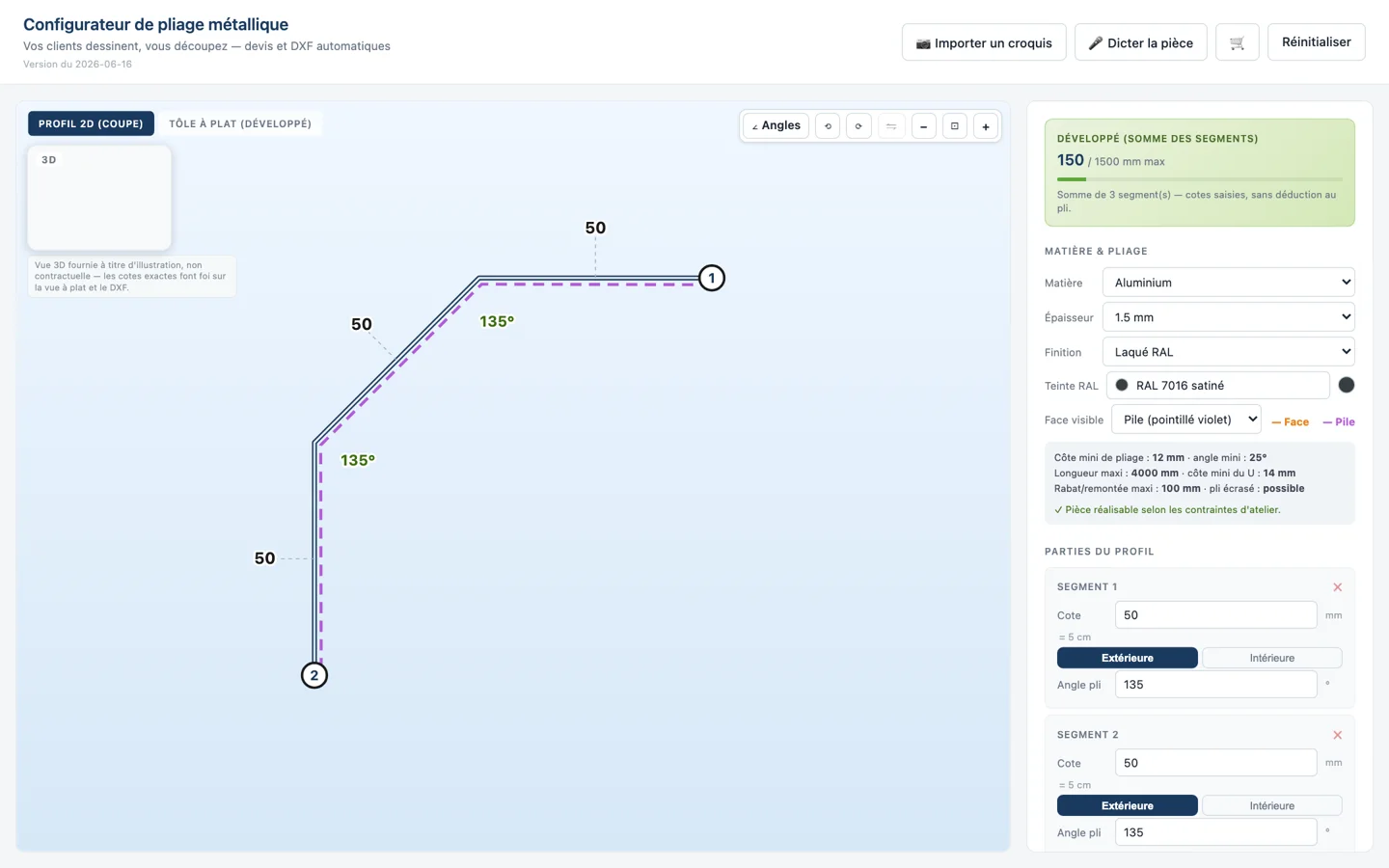
Every length and every angle, taken from a photo of a paper sketch — and the flat blank to cut: 590 mm here, computed instead of measured by hand.
Materials and options Koventor already handles
Quoting costs youmore than the material.
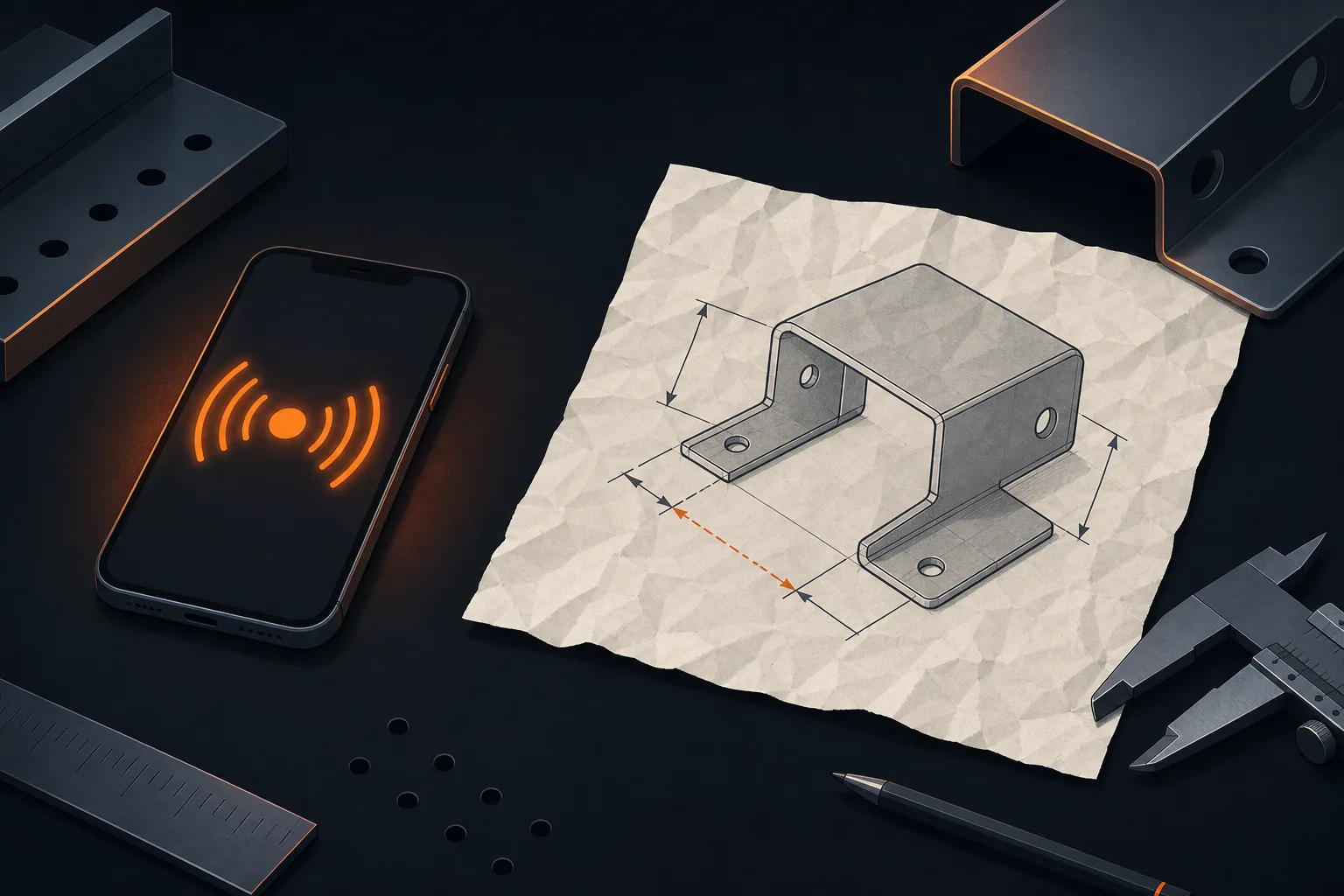
Three calls for one dimension
The customer sends a blurry photo, the angle, thickness and material are missing. Every quote turns into a phone investigation.

Quoting happens after hours
Quotes pile up, get priced after closing, go out late. And meanwhile, the competitor has already replied.
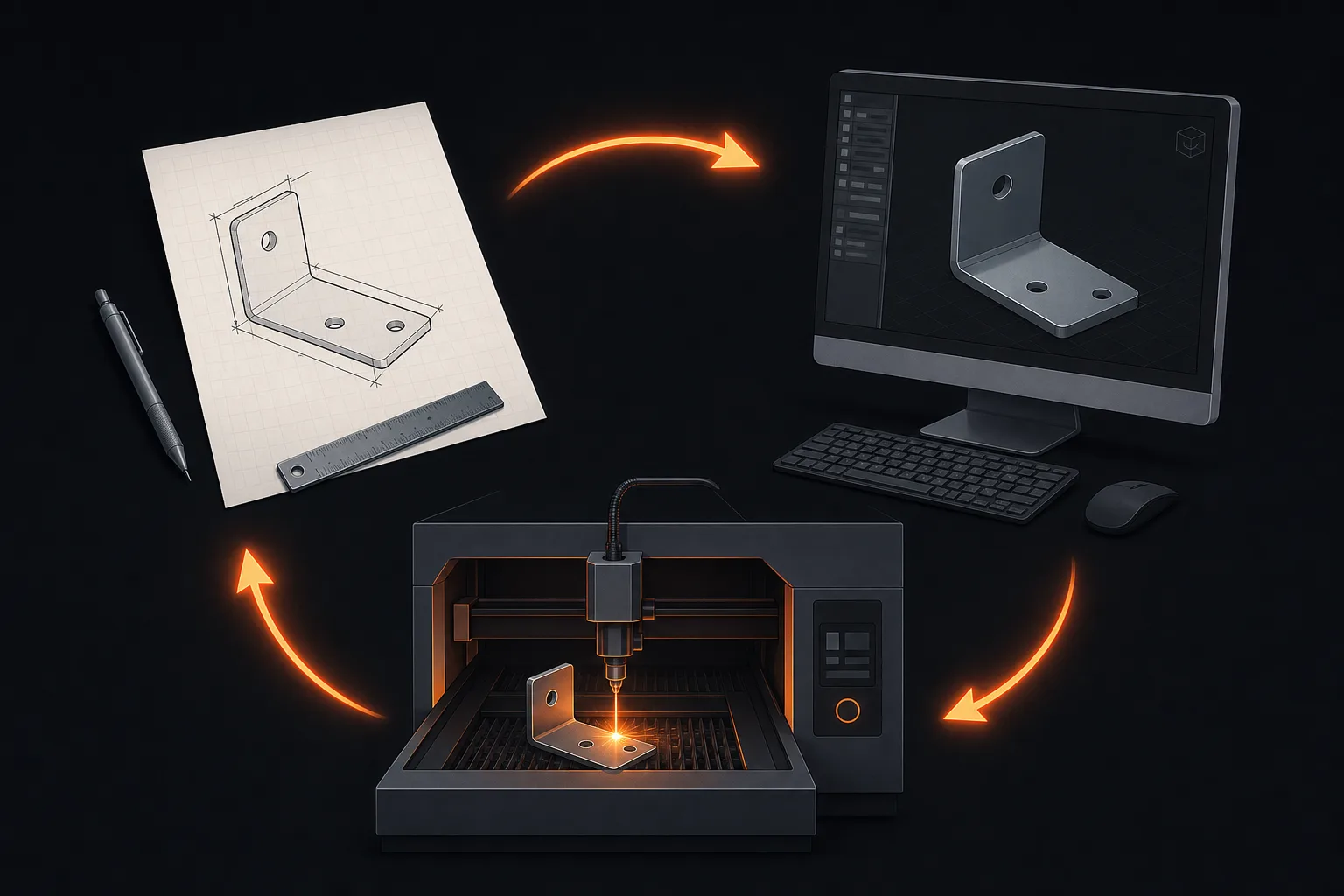
Endless re-keying
Sketch → quote → DXF → bending sheet: the same part, redrawn three times, with an error slipping in along the way.
How it works
From sketch to laser, hands-free.
The starting point
A sketch on the corner of a table.
Crooked lines, dimensions scribbled in pencil, an angle left to guess: that is what your customers actually send you. Everything below happens in the real configurator, starting from a photo of exactly this — scroll and watch the part build itself.
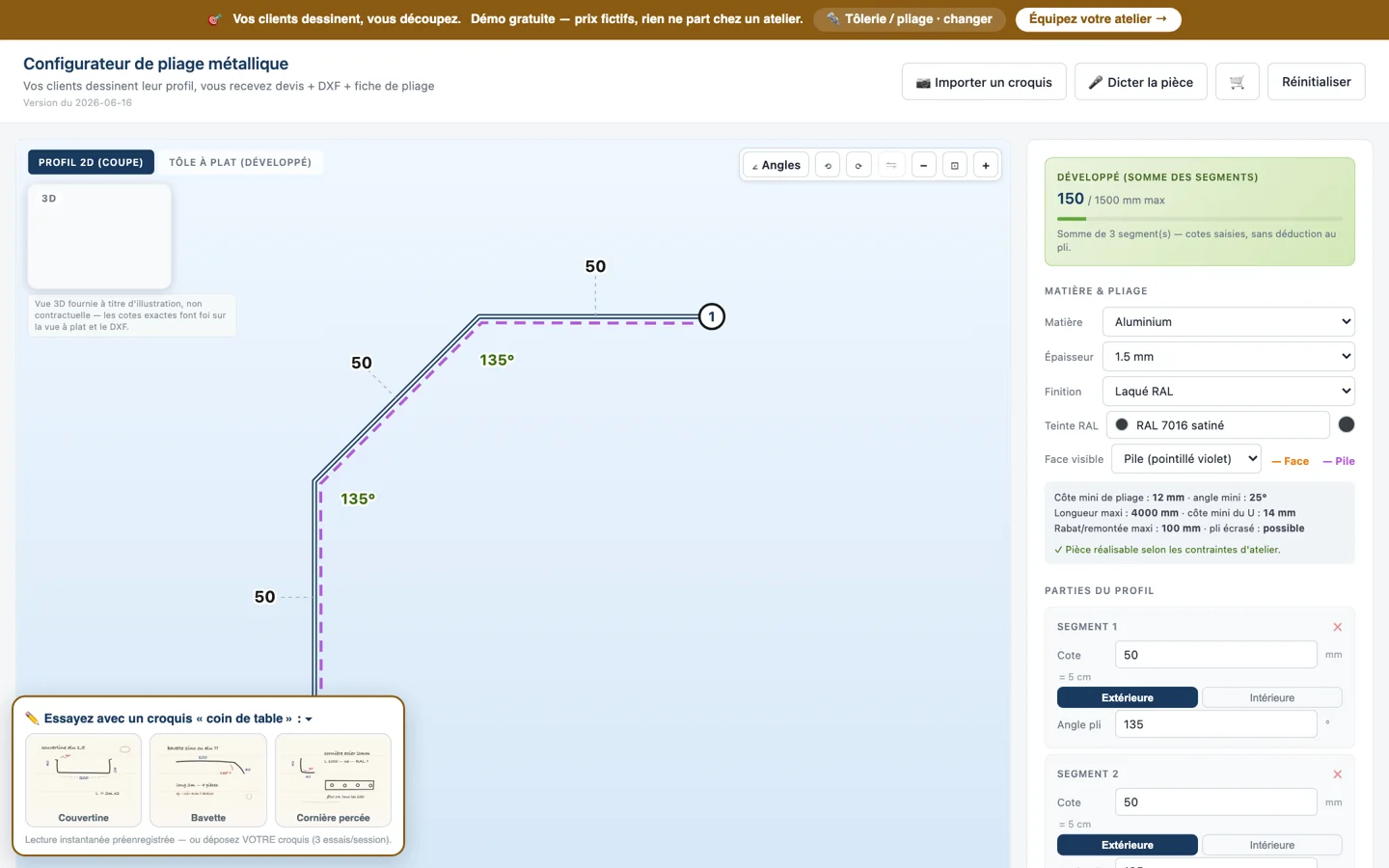
Click to start the real configurator right here (it only loads on demand).
01 — sketch ocr → part
Your customer's sketch, read
A photo of a paper sketch is enough. Dimensions, angles and orientation are read, and anything missing is asked once — at the right moment.
02 — shop constraints
Folded to your shop's limits
Minimum returns, minimum angles, maximum developed length: your constraints, not generic ones. An impossible part is refused with the exact reason.
03 — your price grid
Material, thickness, RAL
Your catalogue drives the choices: a finish filters the thicknesses, and every shade carries its own stock status. No impossible combination is reachable.
04 — dxf + bending sheet
Holes, quote, DXF
Holes are placed on the flat view, the price follows instantly, and the shop gets the DXF and bending sheet. Nothing is retyped anywhere.
Features
Everything Koventor actually does.
Every feature below exists and runs in the demo. Nothing "coming soon."
Sketch reading (OCR)
A photo of a paper sketch comes back as a dimensioned part, orientation detected.
See the pageVoice input
The customer describes the part out loud. Wired up at installation.
See the page3D bent profiles
A three.js view: edge highlights, front and back labels, hole markers.
See the pageRAL colours
Colour picked with a swatch, visible face set explicitly.
See the pageAutomatic pricing
Material, machine time, holes, freight, margin: YOUR workshop's rates.
See the pageOptimised nesting
Parts interlocked by rotation to save material.
See the pageCut-ready DXF
The file goes to your laser without anyone redrawing anything.
See the pageBend sheet + order confirmation PDF
Production paperwork and order acknowledgement generated and sent on their own.
See the pageAutomatic follow-up
Sketch abandoned? The follow-up goes out on its own, with a resume link.
See the pageBattle-tested in production, adapted by trade.
Koventor was designed and battle-tested with a fabrication shop in real production: the constraints, price grid and generated documents come from the field. The same engine configures for other cutting trades:
What each trade needs from a quote:
- Every demo is real and public, no account required
- Your instance = YOUR materials, YOUR constraints, YOUR price grid
- Embeddable into your existing website via a simple script
The blog
Quoting, sketches, the shop: our take
Bending force: working out the tonnage before the run
The air bending tonnage formula, what V width changes, and the three mistakes that reveal a press shortfall once the sheet is already cut.
September 15, 2026Minimum bend radius: the values by material
What minimum inside radius to accept by material and thickness. The orders of magnitude, what moves them, and why too tight a radius cracks the sheet.
September 15, 2026Minimum distance to the edge: the half-V rule
How much room to leave between a bend and a hole, an edge or another bend. The half-V rule, what happens when you break it, and how to tell the customer.
Frequently asked questions
How does Koventor read my customers' sketches?
The customer photographs or uploads their paper sketch. Koventor recognizes the segments, dimensions and angles, orients the part, and only asks for the missing information. The customer can also draw directly in the configurator or dictate their part by voice.
Does Koventor adapt to my shop's constraints?
Yes, that's the heart of the product: minimum bend dimensions, angles, maximum lengths, available thicknesses and materials, price grid, margins. Each instance is configured for a specific shop, and the part is validated against your rules before any quote.
How does it install on my website?
Two options: a dedicated page for your shop, or integration directly into your existing website via a simple script. Installation and the setup of your constraints are done together with you.
How much does it cost?
Pricing depends on your configuration (materials, constraints, integration). Start with the free demo, then let's talk about your shop: you walk away with a clear quote before any commitment.
Is Koventor used in real-world conditions?
Yes. Koventor was designed and battle-tested with a fabrication shop in real production: the constraints, prices and generated documents (DXF, bending sheet, order confirmation) come from the field, not from a theoretical spec sheet.
How many hours of quoting this week?
Try the demo with a real sketch from your shop. Then let's talk about your constraints: you walk away with a clear quote, no commitment.