Acrylic, PVC & signage
One shape, one thickness, one price.
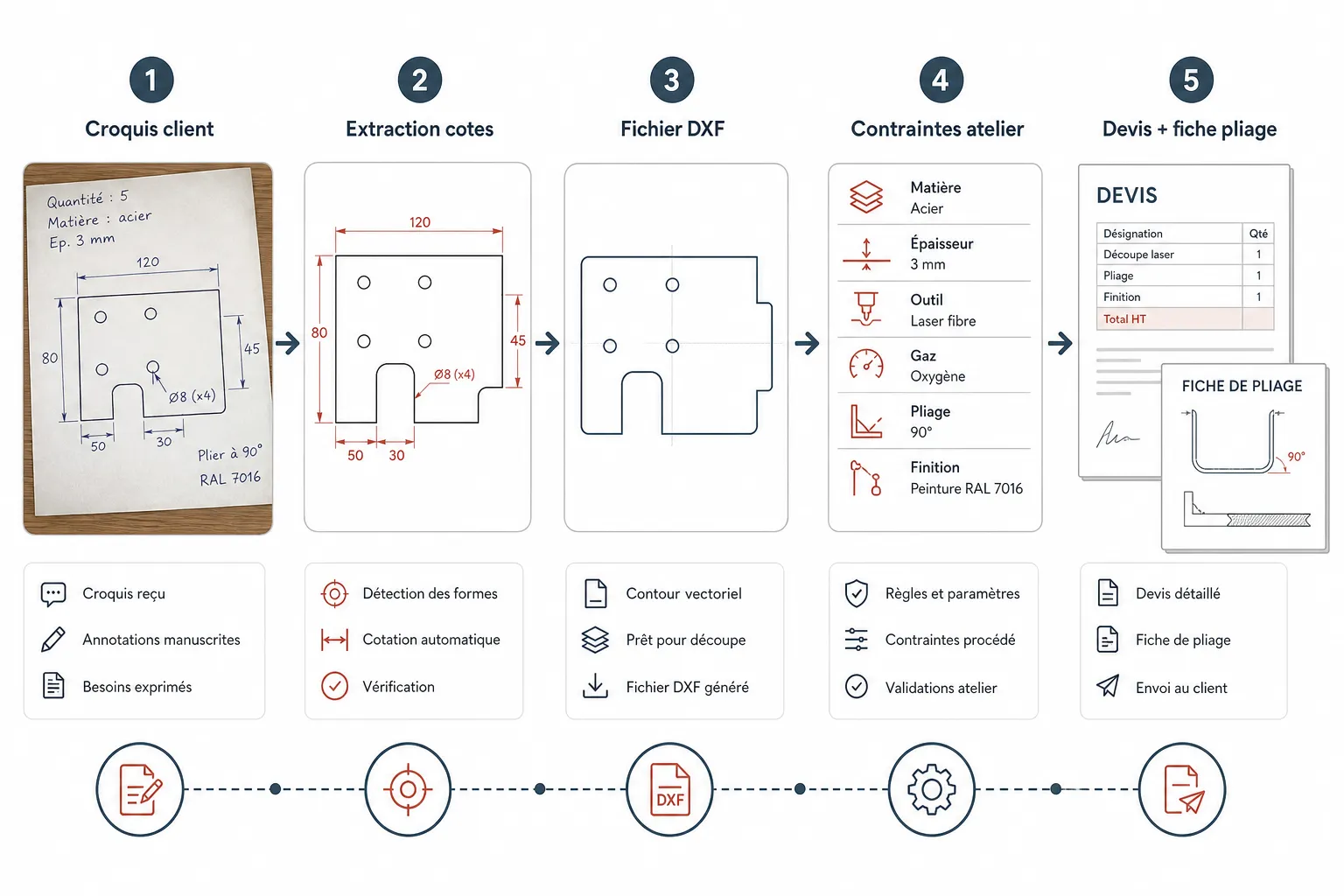
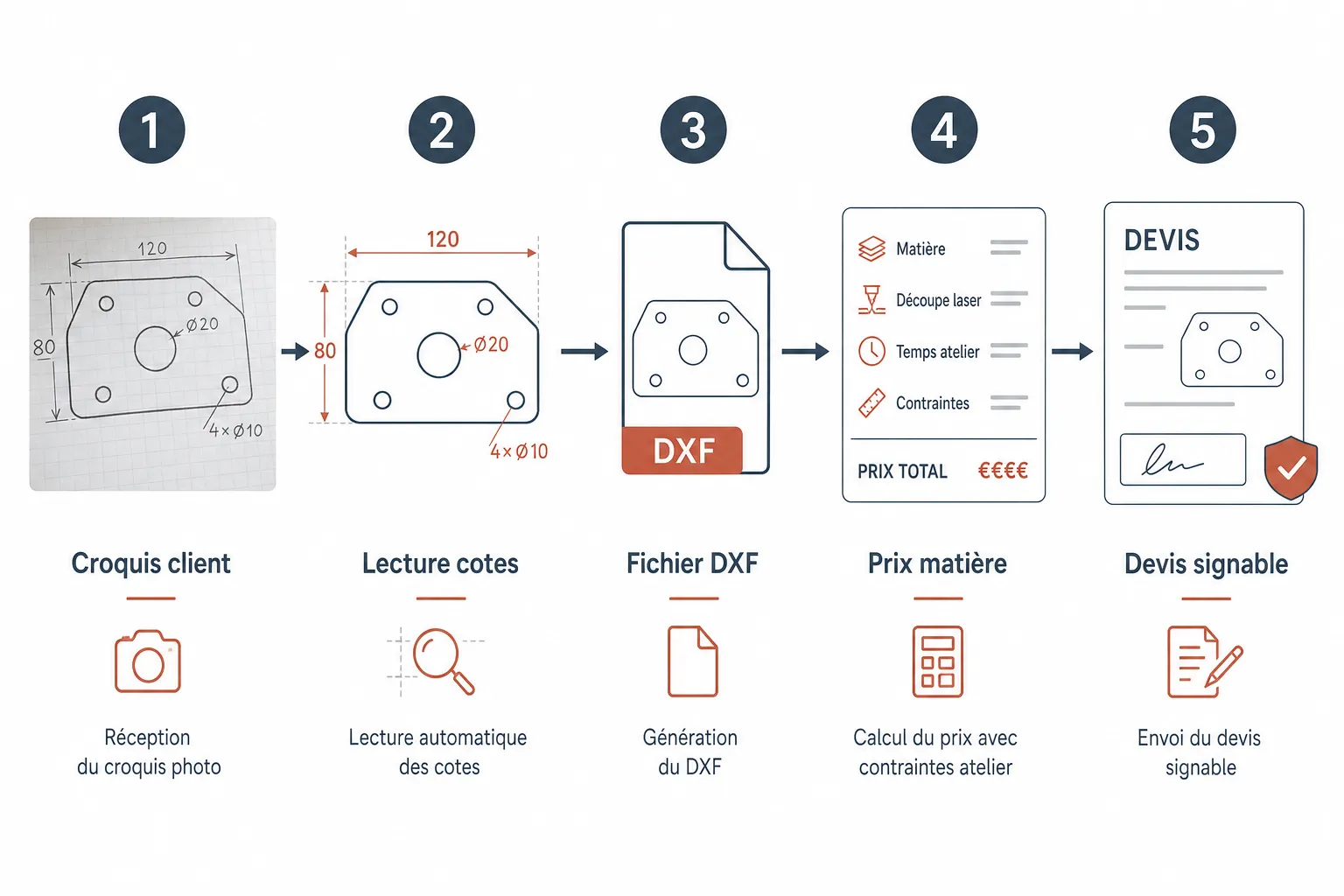
Signage, point of sale, guards, display cases: enquiries arrive as free shapes, usually urgent, almost never as a clean file. Koventor reads the customer's artwork, pulls out the shape and the dimensions, and prepares the pricing with your materials and your finishes.
Demo with no account, fictional prices: nothing reaches a workshop.
What your customers actually send
A sign artwork, a logo to be cut out, a photo of the location with dimensions scrawled on it, or an enquiry along the lines of “an 800 by 600 sheet in 5 mm clear, four 6 mm holes at the corners”.
None of these formats is a production file. They are nevertheless what you have to price from, and that is exactly where Koventor starts.
What the pricing has to produce
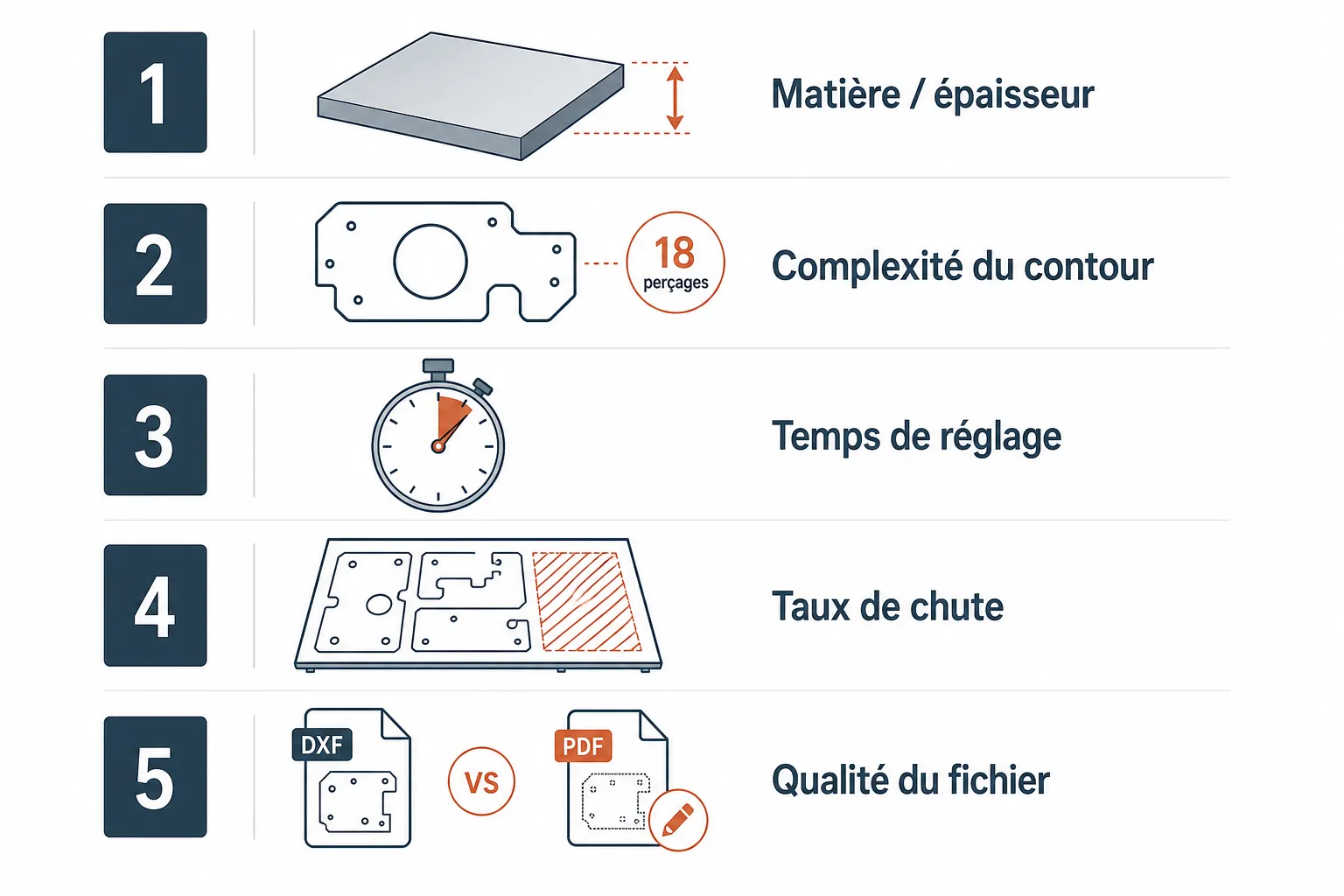
The parameters specific to your trade, the ones that decide whether a price holds.
Material and thickness
Cast or extruded PMMA, polycarbonate, foamed PVC, composite panel: the price per square metre, the behaviour under the beam and the edge finish differ for each. Thickness governs the rest.
The cut shape
A rectangle prices by the square metre. A free shape prices by the linear metre of cut, and it is the perimeter that counts, not the area. A cut-out logo can cost more than a sheet twice its size.
Edge finish
As-cut, diamond polished or flame polished: a distinct price line, and on clear material it is the first thing the customer looks at.
Holes, bending and lamination
Holes, countersinks, line bending, laminating a printed vinyl: each adds machine time, and the customer's enquiry rarely mentions any of them.
What actually bites, and what a generic rate card ignores
The protective film hides the defects
A scratch under film only shows at delivery. The quote has to allow for inspection, not only cutting, or the redo comes out of your margin.
Cast and extruded PMMA are not the same thing
They have neither the same price nor the same behaviour under a laser. Accepting an enquiry from a customer who only says “acrylic” without settling it means quoting one material and delivering another.
Urgency is the rule of this trade
A sign is usually ordered for the same week. A quote that goes out three days later does not only lose the job: it loses the customer for the whole season.
3,350 searches a month
“laser cut acrylic” is searched 1,600 times a month in the United States, “custom acrylic cutting” 1,000, “acrylic sheet cut to size” 590. The demand to order online already exists: the question is who answers it.
Common questions
The customer sends a logo, not a dimension. Does that work?
That is the typical signage case. The system works on the artwork, extracts the outline and asks for the reference dimension, the one the customer actually has in mind, usually the overall width. The rest follows from it.
How do you price free shapes?
By cut perimeter and machine time, not by area. That is precisely the calculation nobody wants to redo by hand on every enquiry, and the one where two manual quotes differ most.
What about small point-of-sale runs?
That is where the tool pays best. Twenty near-identical references priced one by one is half a day. Once the parameters are set, the whole run is prepared in one go.
The other trades
What this would look like on your quotes
Try the demo for your material, then tell us about your workshop: we look at one or two of your recent quotes together and show you what the system makes of them.