Joinery & cabinetmaking
Your customer's cutting list, turned into a quote.
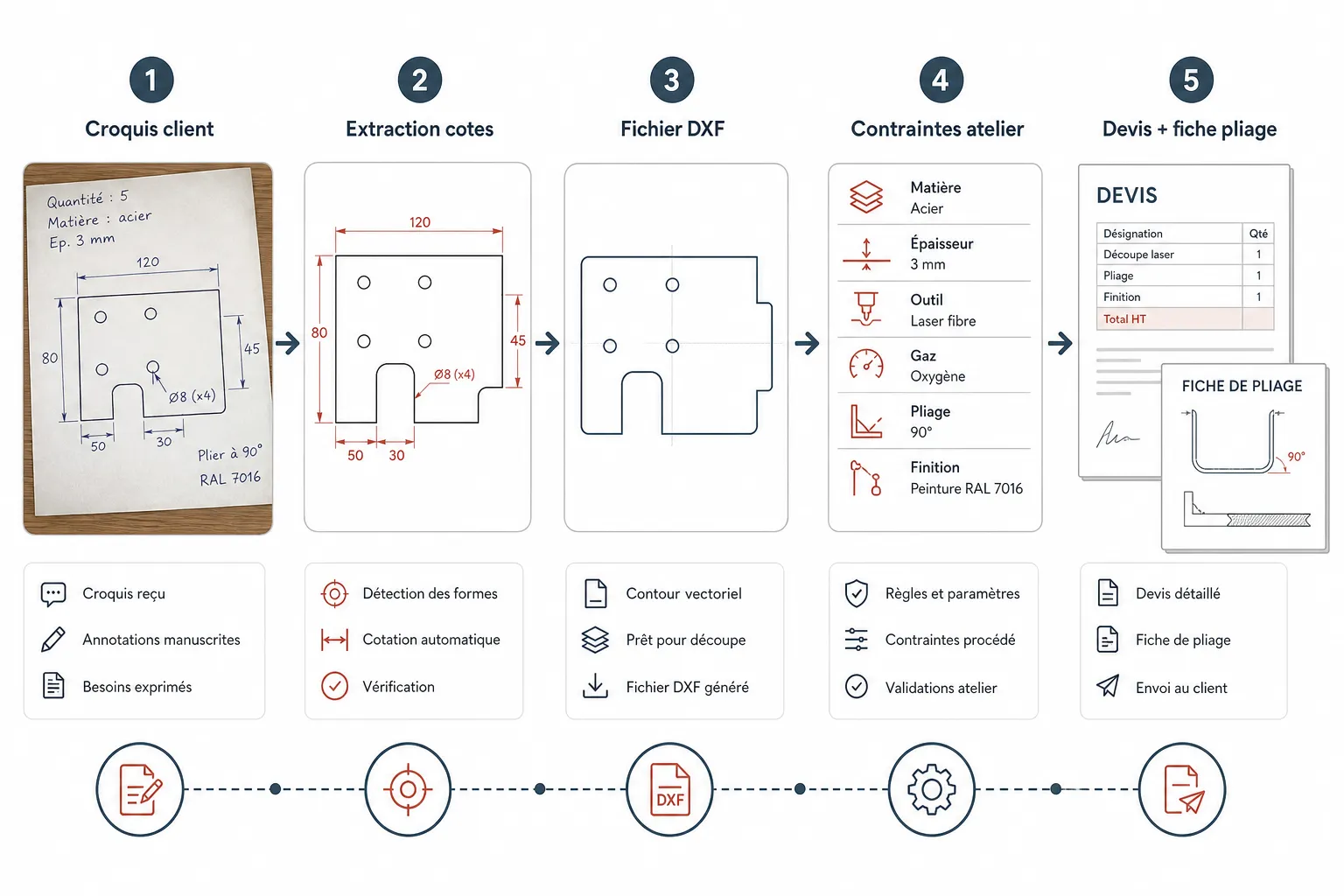
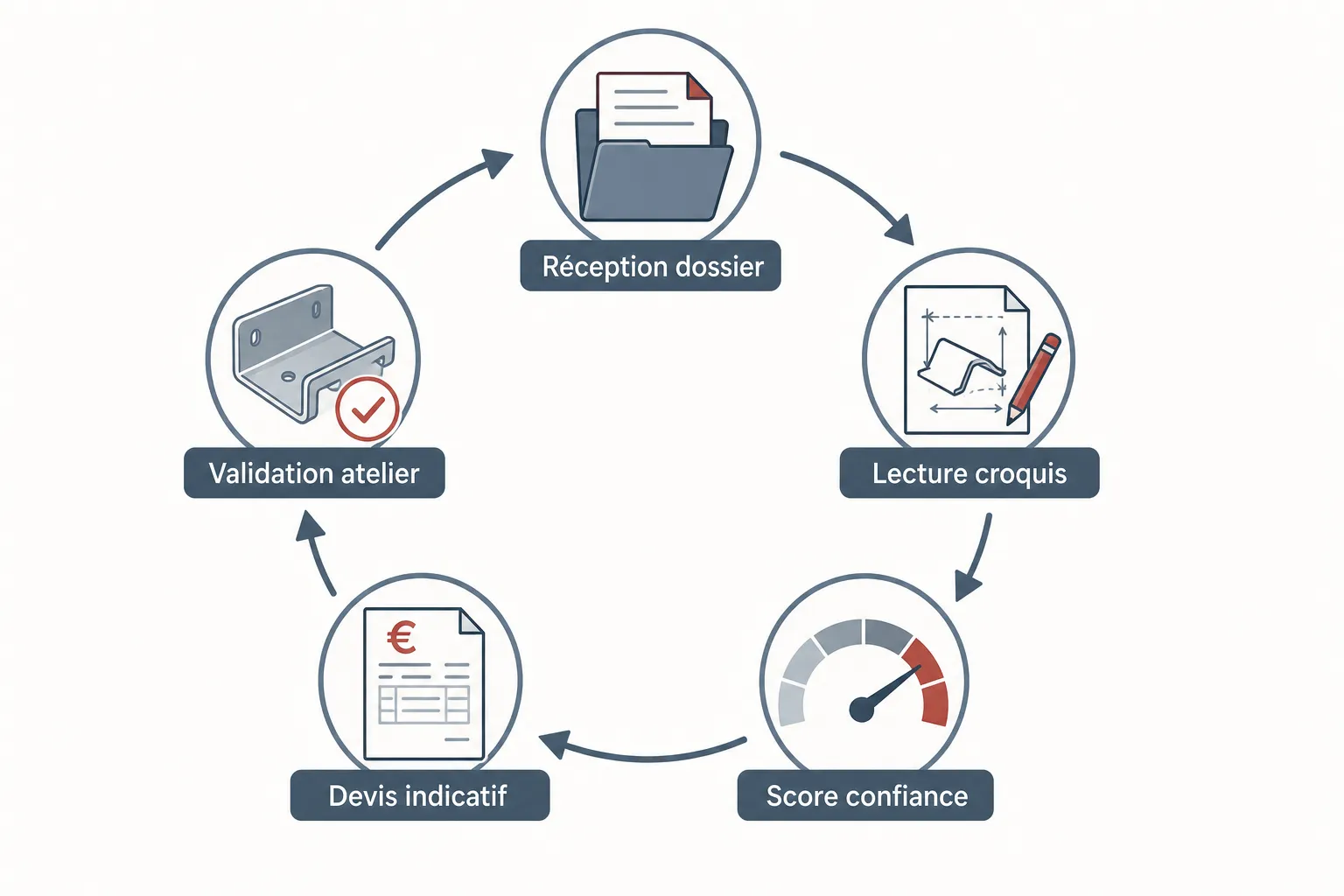
Your customers send a parts list scribbled in a notebook, a fit-out drawing, sometimes just dimensions in a message. Koventor reads that enquiry, structures it into cut parts and prepares the pricing with your boards, your edging and your machine times.
Demo with no account, fictional prices: nothing reaches a workshop.
What your customers actually send
A cutting list typed in a hurry, a fit-out drawing as a PDF, a photo of a notebook page, or a message saying “I need 12 fronts in 19 mm oak, ABS edging on 4 sides”.
None of these formats is a production file. They are nevertheless what you have to price from, and that is exactly where Koventor starts.
What the pricing has to produce
The parameters specific to your trade, the ones that decide whether a price holds.
The board and its thickness
Melamine, raw or veneered MDF, plywood, chipboard, solid timber: the price per square metre varies threefold by reference, and thickness governs both the cut and the drilling.
The cutting list, part by part
Length, width, quantity, and grain direction when the face is veneered. It is the part your customers write worst, and the part that costs most to retype.
Edging
Linear metres of edging is a quote line in its own right: number of edged sides, ABS thickness, colour. Two identical fronts edged differently are not the same price.
Machining and hardware
System 32 drilling, back grooves, rebates, notches. These are machine times, not material: they count by the unit or by the minute.
What actually bites, and what a generic rate card ignores
Offcuts decide the margin
On a 2,800 by 2,070 board, how the parts nest changes the number of boards to order. Pricing strictly by the square metre, without looking at the nest, is wrong in the same direction every time.
Grain direction cannot be recovered
A part cut the wrong way on a veneered board is scrap. When the customer's enquiry does not say, the tool must ask rather than choose for you.
Finished sizes against cutting sizes
A customer usually gives the finished size, edging included. The workshop works in cutting sizes. Confusing the two makes fronts two millimetres too big, sixteen times in a row.
350 searches a month
“custom cabinet doors online” is searched 170 times a month in the United States at $6.74 a click, “cut to size mdf” 90 more. Modest volume, but every one of them is somebody trying to get a price without booking an appointment.
Common questions
Does it replace my quoting software?
No, and it is not the same job. Quoting software helps you write a quote; Koventor decodes what the customer sent you and prepares the pricing before you open anything at all. Plenty of workshops keep their management tool and put Koventor in front of it, where the time is actually lost.
What if the customer gives wrong or incomplete dimensions?
That is the normal case, not the exception. The system spots what is missing, asks the customer for it, and flags what it is unsure about. On a cutting list where thickness appears nowhere, it does not guess: it asks.
My board prices move often, is that a problem?
No, they are parameters. When your supplier moves their rates, we update the matching line and every quote after that accounts for it. You are not rebuilding a spreadsheet.
I mostly do bespoke work, every job is different
Bespoke does not mean unpredictable: the components repeat, even when the dimensions change. Koventor works on those components, and hands back to you on anything outside the frame.
The other trades
What this would look like on your quotes
Try the demo for your material, then tell us about your workshop: we look at one or two of your recent quotes together and show you what the system makes of them.