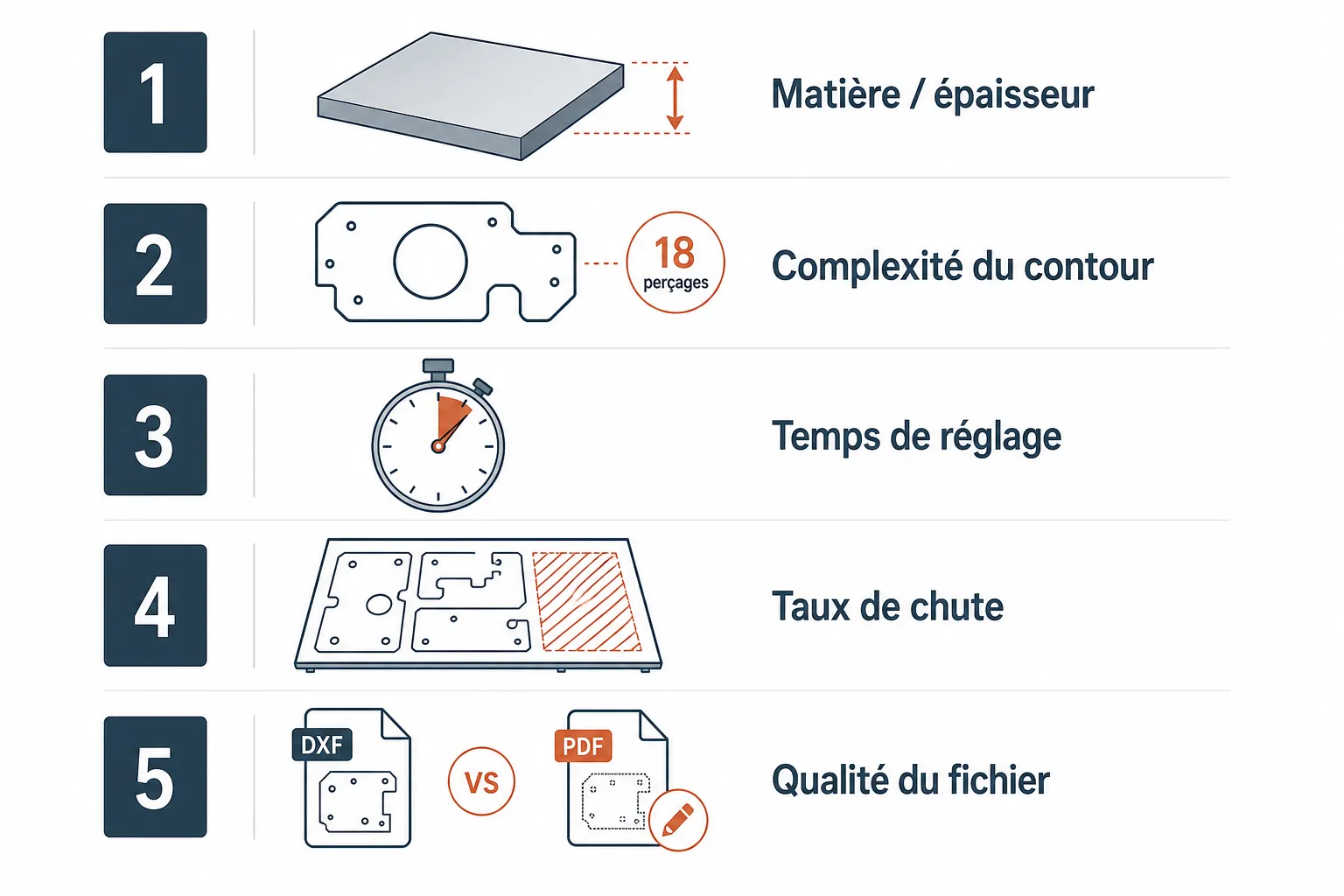
In short: the price of a laser cut is not just machine time. Material, thickness, contour complexity and setup weigh as much, sometimes more. Understanding these drivers is what lets you quote accurately and hold your margin.
Every week a customer sends a scribbled sketch or a scanned PDF and asks for a price the same day. The problem: if you cannot break the cost down quickly, you quote too low or you lose the job by quoting too high. This article goes through what actually pushes a laser cutting price up or down, line by line.
Material and thickness: the base of the calculation
Mild steel, stainless and aluminium do not cut at the same speed. And at equal thickness, cutting speed can vary threefold by material. The slower the machine moves, the longer the machine time, the more the part costs.
Thickness is usually the first cost factor, ahead of the size of the part. Thin sheet cuts fast. Thick sheet needs more power, a lower speed and sometimes a different assist gas. Nitrogen, oxygen and compressed air do not have the same cost or the same edge quality.
What many forget: some thicknesses sit at the edge of the machine's capability. Throughput collapses, scrap increases. The cost runs away without the customer seeing it coming.
Contour complexity: what linear metres do not tell you
A 200 mm square and a part with twenty star-shaped internal cut-outs can have the same area. Their prices bear no relation.
The more complex the contour, the more laser pierces there are, and every pierce costs time. A laser pierce is a full sequence: power ramp, penetration, then cutting. Multiply that by twenty holes and you see why the "simple" part can cost twice what its area suggests.
Internal corners, very short radii and cut-outs deep inside the part also slow the head. The machine decelerates, accelerates, decelerates again. Effective time climbs. It is rarely explained to the customer, but it is real.
Setup time and starting a run
The price of a laser cut always contains a fixed share: importing the file, checking the geometry, nesting it on the bed, setting the machine. On a one-off, that fixed share can be most of the total cost.
On a run, that fixed cost spreads across each part. That is why the unit price drops quickly as quantity rises. But on a prototype or a short run, it is unavoidable.
The classic mistake: failing to value preparation time on the quote because it is thought of as "office work". It is operator time, full stop. It has to appear in the price, in one form or another.
Offcut and nesting: money in the skip
When a part is small or an awkward shape, it leaves a lot of offcut around it. That offcut is material bought and paid for that ends up recycled.
A good nest reduces the offcut. But nesting parts of different shapes takes time. And if the customer orders only one reference in small quantity, an optimal nest is often impossible.
The offcut rate is a real cost that many workshops do not carry explicitly in their rate card. They absorb it into the margin, then wonder why they no longer know which orders are profitable.
What makes the price move between orders for no visible reason
Two orders identical on paper can cost differently depending on the state of the order book. A machine running flat out may refuse a small order or price it with a rush premium. An available machine will take the same part at standard rates.
Source file quality matters too. A clean DXF means zero rework. A crooked scanned PDF with approximate curves means twenty minutes of correction before the machine starts. If you are on the workshop side you know exactly what that means. If you want to cut that line, a tool that reads sketches and generates a clean DXF directly changes things from the moment the customer's file arrives.
Incoming file quality is usually the easiest lever to pull on preparation cost. And it is the only lever that depends neither on the machine nor on the customer, but on your own process.
My view
I have seen plenty of estimators price a laser cut from weight or area and stick to it. That is a mistake that costs.
The real calculation runs on four things: effective cutting time (which depends on material, thickness and complexity), setup and preparation time, the offcut rate, and source file quality. Those four do not all move the same way from one order to the next.
My advice: formalise an internal rate card that values each of those separately, even if the final quote is presented to the customer as one figure. You will quickly see which orders are genuinely profitable and which eat margin invisibly. To move faster on the file and quote side, have a look at what Koventor does on its home page.
Common questions
Why does the unit price fall so much on a long run? Because setup and preparation cost is fixed and divides across every part. The longer the run, the less that fixed cost weighs.
Should a customer who supplies a scanned PDF instead of a DXF pay more? Not necessarily, but the file rework time is real. Some workshops invoice it as a drawing charge, others absorb it. Better to have an explicit rule.
How do you explain to a customer that their part with ten holes costs more than a part twice the size? Tell them each hole is a separate laser pierce with its own start sequence. Machine time follows the number of pierces, not only the area cut.