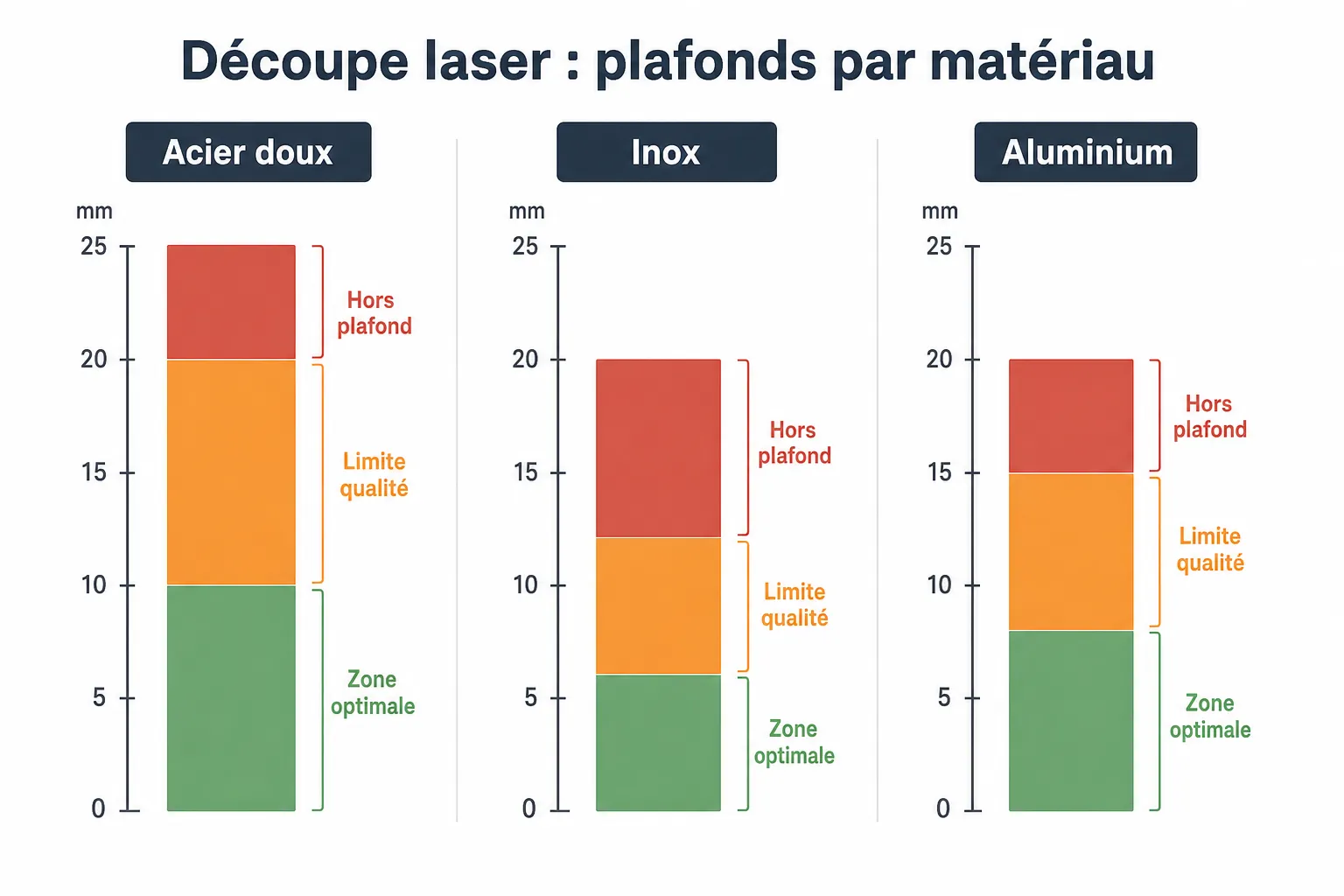
In short: laser cutting works on most common steels, stainless grades and aluminium alloys, but each material has its real thickness ceiling. Past it, cut quality drops, costs climb, and the workshop loses time. Here is what to know before quoting.
What laser cutting genuinely does well
Laser cutting is at home on complex geometry, short runs and tight tolerances. It cuts without contact, without a tool that wears part after part, and leaves a clean edge at suitable thicknesses.
On mild steels and thin to medium stainless, it is the most profitable process for most workshops. Closed contours, notches, slotted holes: all of it comes out in a single pass. No manual rework if the settings are right.
The customer does not see any of these constraints. They send a sketch and expect a price. That is where the estimator has to ask the right questions quickly.
Thickness: the ceilings to know, by material
There is no single universal ceiling. It all depends on machine power, the gas used and the material.
The main families:
-
Mild steel (S235, S355): current fibre lasers reach high thicknesses, but past a certain limit cut quality degrades noticeably. Nitrogen is no longer enough, you need oxygen, and the edge oxidises.
-
Stainless (304, 316L): nitrogen cutting gives a bright edge at low and medium thicknesses. The thicker it gets, the more speed drops and the more the price climbs.
-
Aluminium: a reflective material, long difficult to cut on a CO2 laser. Fibre handles it better, but thick aluminium stays delicate. Burr appears sooner than people expect.
-
Copper and brass: highly reflective. Some machines refuse them or demand very specific parameters. Check machine by machine.
The shop-floor rule: the closer the thickness gets to the machine's ceiling, the more speed drops and the more cutting time climbs. It is not linear. Twenty-millimetre steel does not cost twice as much to cut as ten-millimetre.
The limits customers cannot see
A customer sends a drawing with a small slotted hole in the middle of a thick part. They do not know the diameter-to-thickness ratio has a physical limit. Below a certain ratio, laser cutting cannot guarantee the geometry.
Other common limits the workshop should flag before confirming a quote:
-
Webs too thin between two cuts: the part can move or burn locally.
-
Text or engraving on thick stainless: resolution degrades.
-
Parts very large relative to the bed: it sounds obvious, but drawings that cannot be nested still arrive.
-
Coated materials: galvanised, pre-painted, epoxy coated. The laser burns the coating, releases fumes, and the edge usually needs rework.
What wastes the most time is the estimator discovering these problems after sending the price. Better a round trip to the customer before committing.
If you receive customer sketches as paper or scanned PDFs and need to turn that sketch into a usable quote quickly, that is exactly what Koventor addresses.
Assist gas: oxygen or nitrogen changes everything
The gas choice is not a detail. Oxygen cuts thick steel fast but oxidises the edge. Nitrogen gives a clean silver edge, especially on stainless, but it is slower and more expensive to consume at high thicknesses.
On a quote, the gas used directly drives machine time and therefore the final price. A customer asking for a bright edge on thick steel with nitrogen will pay significantly more than they imagine.
A sharp estimator asks what the edge is actually for: is it visible? Is it welded behind? If the part goes to blasting or paint, oxidation is not a problem.
What laser cutting does not replace
Laser cutting is not always the right process. At very high thicknesses, plasma or oxy-fuel stay faster and cheaper. On production runs with wide tolerances, punching can be more competitive.
Laser cutting sheet is also limited to flat shapes. It does not go around a tube without an optional rotary axis. It does not produce weld preparation chamfers straight off the bed, except on specific machines.
Offering the right process is also what builds loyalty. A workshop that says "we can do this another way and it will cost less" gains credibility. To see how workshops handle these trade-offs in practice, the Koventor use cases give some field examples.
My view
Laser cutting is a powerful process, but it is often oversold as universal. On the shop floor, the real pain comes from limit thicknesses, reflective materials, and customers who send drawings without naming the material or the thickness.
My advice: build a clear internal table by material and thickness, with your specific machine's limits. Put it inside your quoting process. It is not a software question, it is a method question.
The estimator who asks the right questions when the sketch arrives saves pointless round trips and nasty surprises in production.
Common questions
Can you laser cut aluminium? Yes, with a fibre laser. But aluminium is reflective and the burr risk increases with thickness. Past a certain thickness, other processes suit better.
What is the maximum thickness in mild steel? It depends on machine power. High-power fibre lasers go fairly high, but cut quality and speed degrade progressively. Always ask your subcontractor for the real parameters.
Can galvanised go under the laser? Technically yes, but the zinc burns and releases toxic fumes. Many workshops refuse it or charge a surcharge. The edge usually needs rework. Anticipate that before promising a lead time.