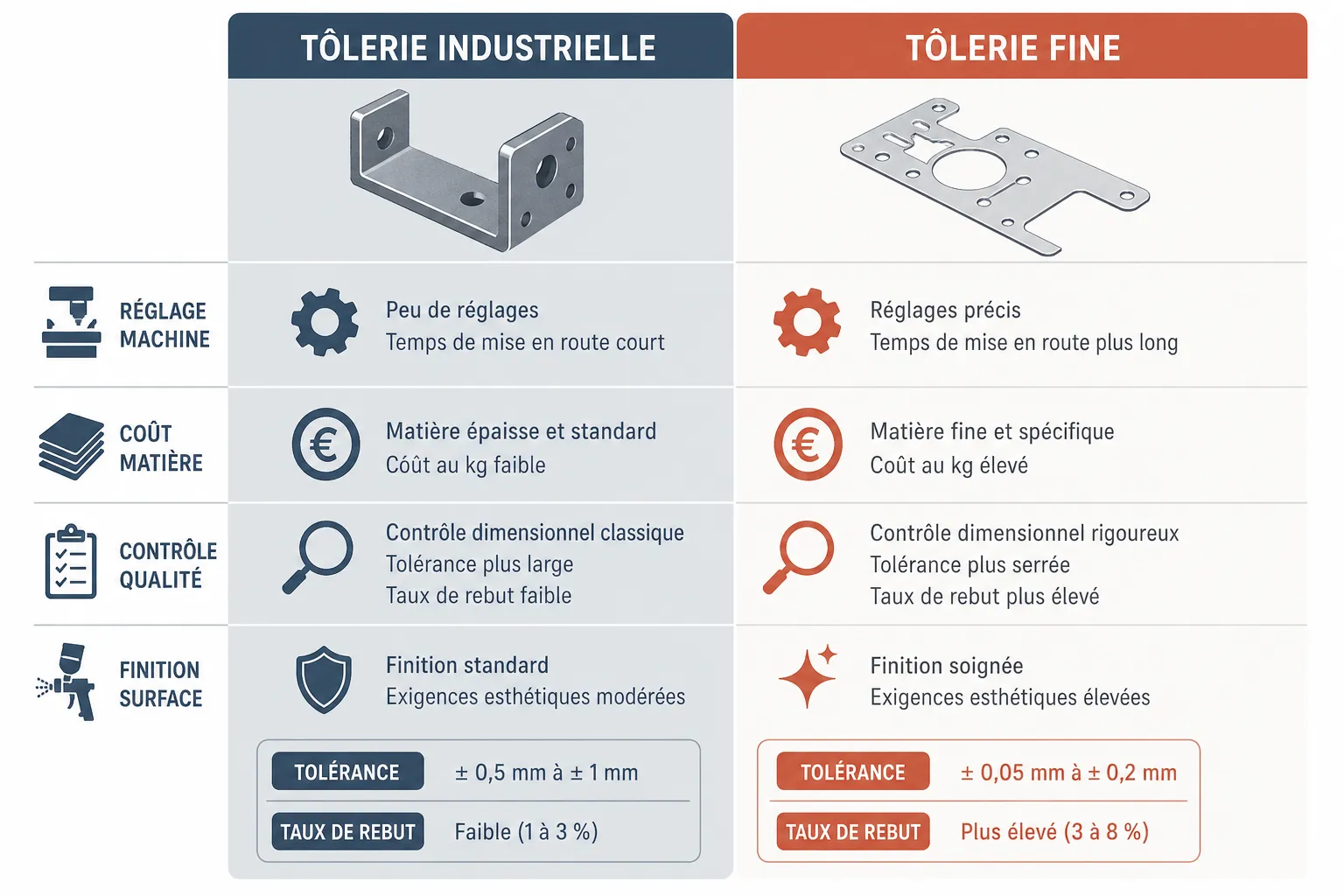
In short: in heavy fabrication you price thick material, short runs and wide tolerances. In precision sheet metal it is the opposite: tolerances tighten, materials cost more and the smallest omission sinks the margin. The two worlds share the same basic machines, and none of the same pricing logic.
When a customer drops a sketch on your desk, the first question is not "which machine?". It is: which world are we in? Heavy or precision? The answer changes everything: setup time, offcut rate, bending difficulty, and in the end the price you quote. Misreading that at intake means either losing the job or losing money.
Heavy fabrication: what it actually covers
Heavy fabrication means working thick sheet, usually black or galvanised steel, for structural or functional parts. Light steelwork, machine guarding, conveyor frames, heavy brackets. Thicknesses start where precision sheet metal stops.
Tolerances are wide compared with precision work. A few tenths of clearance bothers nobody. What counts is mechanical strength and ease of assembly. In heavy fabrication, material weight is often the first cost line, ahead of labour.
Parts are rarely complex geometrically, but they are often large. And large means handling time, press brake capacity, laser or plasma cut length. Pricing has to account for these constraints from the start.
Precision sheet metal: where every tenth costs
Precision work handles thin material, usually stainless, aluminium or treated steel. Electrical enclosures, industrial body panels, decorative elements, protective housings. The geometry can be highly worked.
Tolerances tighten. A flatness defect visible to the eye, a surface scratch, a miscalculated bend radius: the part is scrap. Precision work punishes the approximations heavy fabrication absorbs without blinking.
Materials cost considerably more per kilo. Brushed stainless, anodised aluminium, special alloys: material cost is a sensitive line. And machine setup takes longer, because the margin for error is smaller. All of that has to go into the quote.
The four points where pricing genuinely diverges
Between the two worlds the differences are not only thickness. They touch the structure of the price calculation itself.
- Material: in heavy fabrication steel is affordable and offcut is usually recyclable. In precision work, stainless and aluminium offcut has value, but the offcut rate weighs heavily on a small part.
- Setup and tooling: a thin part needs more care at setup, sometimes specific tooling (a soft bending die, protective film). That time does not show on the drawing, but it costs.
- Inspection: in precision work inspection is systematic. In heavy fabrication you check the critical dimensions, not the whole part.
- Finishing: precision work often includes a surface finish within the scope of the part. Deburring, brushing, protection. In heavy fabrication, paint or treatment is usually a separate line.
When a sketch arrives with no thickness and no material, that is where errors slip in. The estimator assumes. And assuming, in precision work, gets expensive.
The classic mistake: one rate card for both
Plenty of workshops doing both keep a single machine-hour rate. It is convenient, and it is wrong.
Setup time is not the same. The probability of scrap is not the same. Raw material cost is not the same. Applying the same hourly rate to a 0.8 mm stainless part and to a 6 mm steel bracket guarantees a disastrous margin on one or the other.
Good practice is to hold distinct coefficients by the kind of part, not only by the machine used. Some workshops do it intuitively but never write it down. The result: the most experienced estimator copes, their replacement gets it wrong.
If you regularly handle mixed work, look at how a sketch-to-quote configurator can help you apply these rules systematically, without depending on anyone's memory.
Reading a customer sketch to identify which world you are in
A customer's sketch does not always say explicitly. But there are signals.
- Thickness stated or not: if it is missing, ask before any calculation.
- Material named: "304 stainless" and "S235 steel" are not read the same way.
- Tolerances noted: tight ISO tolerances usually mean precision work.
- Finish requested: "visible surface" or "ready to paint" changes the level of demand.
- Quantity: a long run in heavy fabrication can justify dedicated tooling. In precision work, even short runs demand constant care.
A misread sketch is a wrong quote. And a wrong quote means either an unhappy customer or a workshop working at a loss. Both are avoidable.
To see how real workshops sort this at intake, the use cases detailed by part type give useful reference points.
My view
My advice: treat heavy fabrication and precision sheet metal as two distinct trades, even if your machines do both. The pricing rules do not transfer.
The real risk is habit. You are used to pricing heavy work, a precision job arrives, you apply the same method, and you get the quote wrong. The error does not show immediately. It shows when the part goes to scrap or when the month's margin is zero.
Write both rate cards down, even roughly, rather than keeping everything in one estimator's head. Passing on pricing rules is often the weak point of small workshops. The day the person who knows goes on holiday, everyone is stuck.
Common questions
Can a workshop do both without specialising? Yes, many do. But you need distinct pricing rules for each. Otherwise the margin on one offsets the losses on the other, and you never really know where you are making money.
How do I tell whether a part is precision or heavy work when the customer gives no thickness? Look at the material, the tolerances and the finish requested. If two of those three point towards demanding work, treat the part as precision. When in doubt, ask before quoting. It is always faster than redoing the quote.
My experienced estimator makes the distinction naturally. Is that enough? It is enough while they are there. The day they leave, or are away, the rules have to exist somewhere. A written rate card, however simple, beats knowledge that was never passed on.