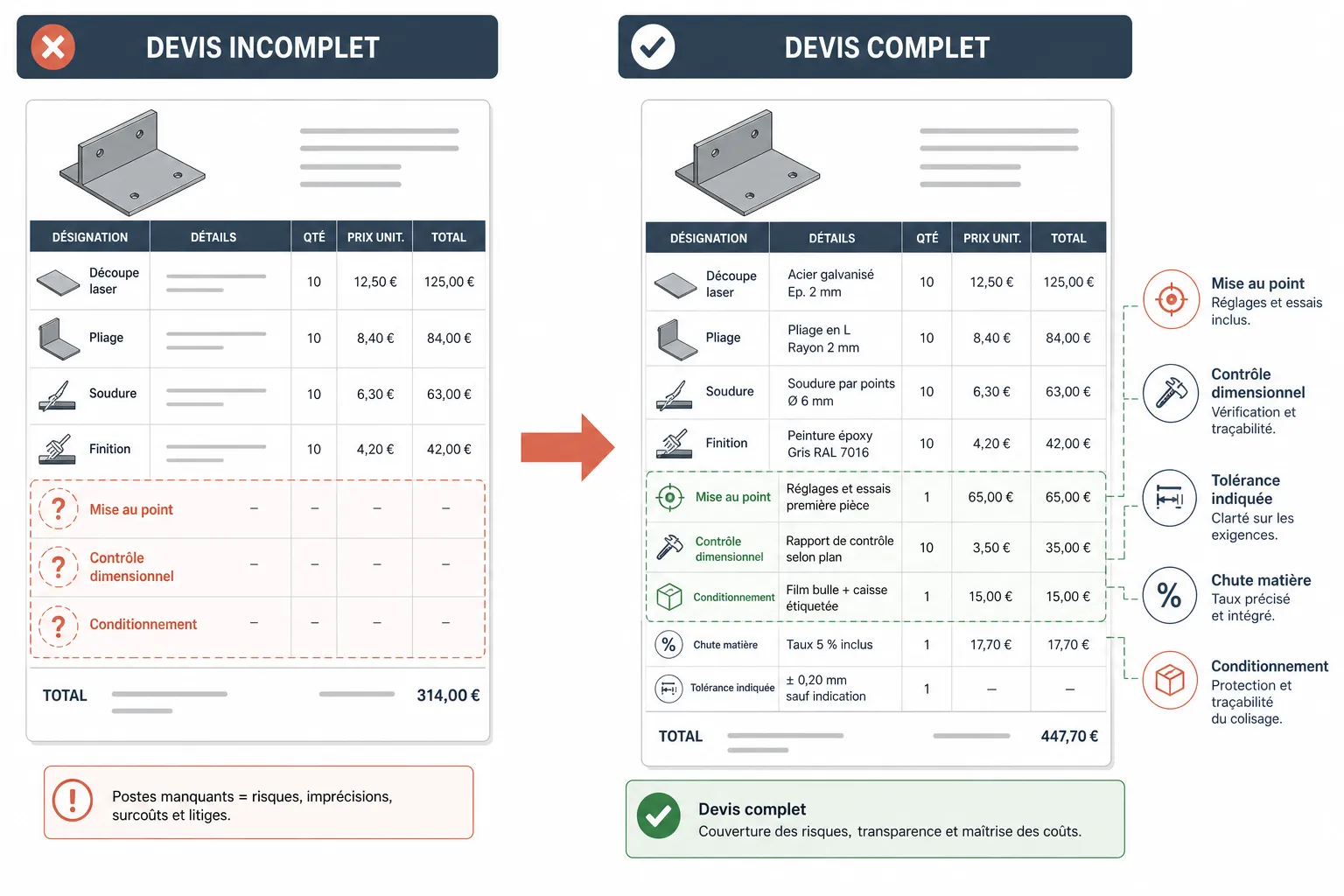
In short: precision sheet metal means working thin material, often below three millimetres, where every tenth of a millimetre counts. Tolerances are tighter than in heavy fabrication, and quoting without knowing them exposes you to expensive rework. Here is what to master before sending a quote.
What precision sheet metal actually covers
The term is common, but it covers very different realities from workshop to workshop. In precision sheet metal you work thin material, usually mild steel, stainless or aluminium. Thickness can go quite low, sometimes below a millimetre.
It is not only a question of thickness. Precision sheet metal means parts where the deformation during cutting or bending changes the final result entirely. Get the bend radius wrong on 0.8 mm sheet and the part is scrap.
The sectors ordering these parts are varied: electronics, medical, food processing, technical furniture. All of them arrive with hand-dimensioned sketches, sometimes photos, rarely a clean DXF.
Tolerances in precision sheet metal: what really changes
Here, the general tolerances of ISO 2768 are often not enough. Customers expect tight tolerances without always stating them. That is the first trap.
Concretely, several things create deviations:
- Springback after bending. It varies with the material, the grain direction and the thickness. On thin sheet it is sometimes hard to anticipate without having worked that material before.
- Flatness. Thin sheet poorly clamped during laser cutting can warp slightly. That can be enough to miss an assembly.
- Bend allowances. The minimum inside radius depends on thickness. Ignoring it risks a crack or a tear.
When the customer states no tolerances, the estimator has to infer them from context, or ask before quoting. Waiting for delivery to discover the problem means losing twice: on the remake and on the relationship.
Reading a precision sheet metal sketch without getting it wrong
Most sketches arriving in a workshop are hand drawings or scans. On a precision part, every misread dimension can trigger a cascade of errors.
A few things to watch:
- Bend dimensions given as flat lengths or as finished dimensions are not the same thing. Check before programming.
- Undimensioned radii. Customers often draw a sharp corner. You have to interpret according to the tool's capability and the actual thickness.
- Holes near edges or near bend lines. In thin material the metal is fragile. A hole too close to a bend tears or deforms.
A sketch well interpreted up front avoids a call back to the customer, a bad machine setting and a part to remake. That is usually where the profitability of a short run is decided.
Quoting precision sheet metal: the lines that derail the price
Quoting fast does not mean quoting wrong. But in this work certain lines are regularly underestimated.
Setup. On thin parts, the first setting pass takes time. The operator often has to adjust cutting speed, bending pressure, gauge position. That time is not in the material price.
Offcut. Thin sheet is usually cut as small nested parts. Nesting takes programming time. And if the customer orders a single part, the offcut is rarely recoverable.
- Surface treatment. Some customers in this field demand an aesthetic finish. Scotch-Brite, satin finishing, passivation: each step has a cost and a lead time.
- Packing. Thin sheet scratched in transit is a return. Protecting each part takes time.
- Tight tolerances not allowed for on the quote. They lengthen inspection and any rework.
The line most often forgotten in a precision sheet metal quote is dimensional inspection time. On tight-tolerance parts, measuring properly sometimes takes as long as bending.
My view
Precision sheet metal is profitable when you genuinely master it. But it forgives very little approximation at quoting time.
My advice: refuse to quote on an unclear sketch without asking the customer at least two questions. The actual material thickness, and the expected tolerance on the critical dimension. Two minutes of clarification avoids two hours of remaking.
If your workshop starts receiving precision enquiries regularly, write your manufacturing constraints down. Minimum radii, bend allowances, the standard tolerances you apply by default. Share them with your customers. It reduces misunderstandings and positions your workshop as serious.
To see how other workshops handle this kind of complex enquiry day to day, the concrete use cases from similar workshops can give useful ideas.
Common questions
Below what thickness do we call it precision sheet metal? There is no fixed universal definition. In practice most workshops put it below three millimetres, sometimes less depending on the material. Thin aluminium and thin stainless do not behave the same way.
Should you apply a different tolerance if the customer states nothing? Yes. Applying the general tolerances of ISO 2768 is common practice, but it has to be stated on the quote. If the customer has tighter requirements, better to know before starting.
How do you avoid misreading a scanned sketch? Work on an enlarged version of the scan, check critical dimensions for geometric consistency, and call the customer about anything ambiguous. A configurator that reads sketches and flags inconsistencies, like the Koventor configurator, helps reduce that risk up front.