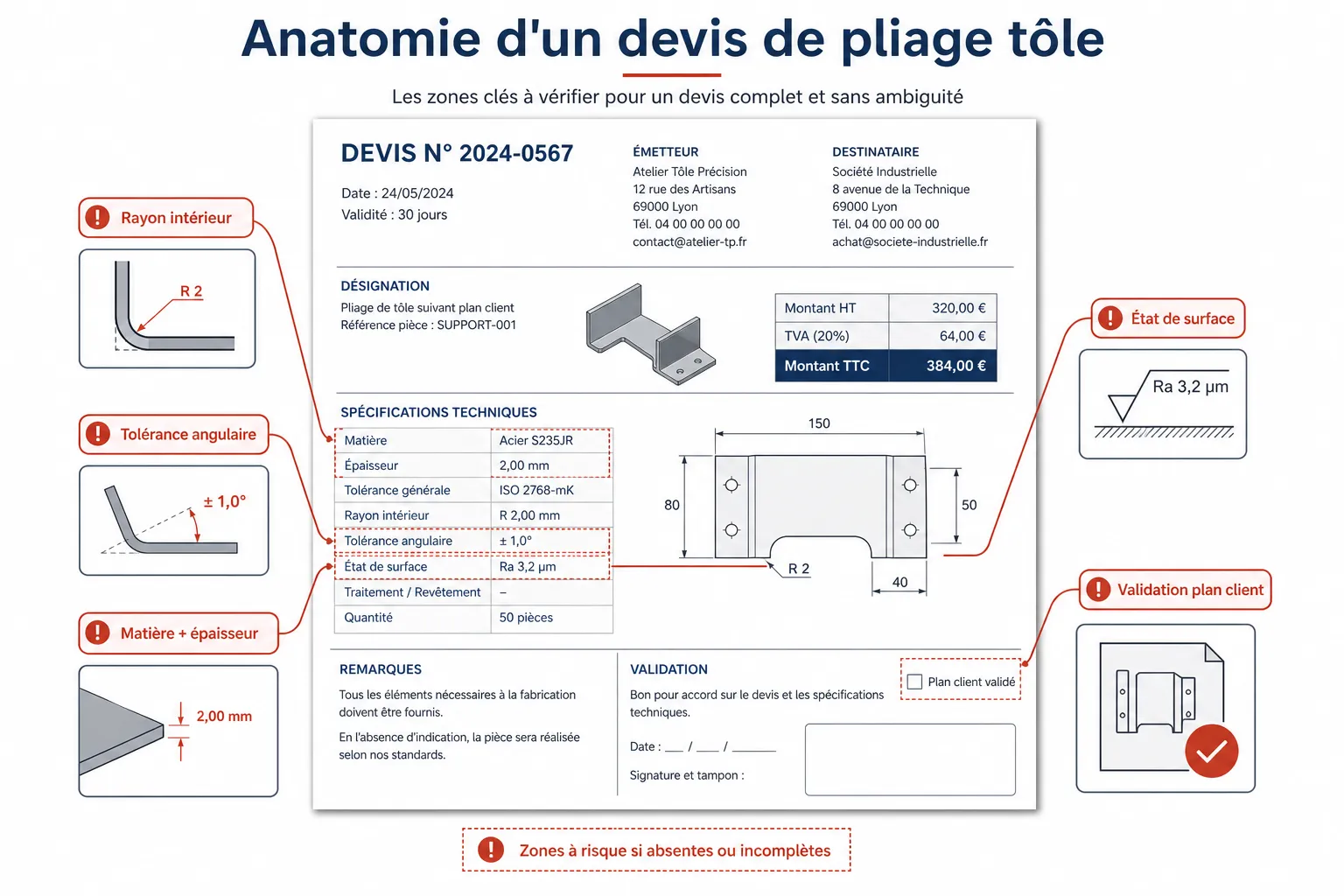
In short: a sound sheet metal bending quote has to state the material, the thickness, the inside radius used, the dimensional tolerances and the finishes. Without them you expose your workshop to challenges and to rework you cannot invoice. Here is what belongs on the document, why it jams in practice, and how to anticipate it when you read the customer's sketch.
What the customer sends versus what you need
Most sketches arriving in a workshop are incomplete. A customer draws a part by hand, dimensions a few things, forgets the thickness or writes just "stainless". And you have to produce a bending quote from that.
The problem is not bad will. They do not know what you need in order to bend accurately. They do not know about flat lengths, bend deduction, or which tool radius you have on the shelf.
That gap between the sketch received and the data actually needed is where most post-delivery disputes are born. Not in machining, not in shipping. In the interpretation of the original quote.
What has to appear on a bending quote
A bending quote is not a simplified order form. It is a contractual document. It commits your workshop to what you are going to produce, not to what the customer pictured.
Here is what must appear, without exception:
- The exact material (DC01 steel, 304 stainless, 5754 aluminium, not just "metal")
- The thickness used and its accepted tolerance on receipt
- The inside bend radius applied, which depends on your tooling, not on the customer's drawing
- The grain direction if the part requires it
- Tolerances on the bent dimensions (angles, flange lengths)
- The surface condition delivered (burrs, deburring, protection)
- The quantity and the packing method if the part is fragile
Leaving the inside radius off the quote exposes you to a legitimate rejection by the customer, even when your bending is technically faultless. They may have designed an assembly with a clearance calculated on a different radius.
Bend radius and flat length: why it changes the whole price
The inside radius is not a detail. It changes the flat length, and therefore the blank you have to cut. A radius different from the one expected can make a part unusable even when it is bent perfectly.
In practice, plenty of workshops apply their standard tool radius without telling the customer. It is a classic communication failure. The customer sees an outside dimension on the part, it does not match their drawing, they object.
Always state the tool radius used on the quote, and note that the flat length was recalculated accordingly. One sentence is enough. It protects you. It also avoids a returned part paid for out of your own pocket.
If you use a configurator to automate sketch reading and quote generation, that flat length calculation has to be fixed in the document produced, not left in a corner of your head.
Tolerances: what you accept and what you guarantee
Your press brake has its own drift. A 90° angle on a drawing can come out at 89.5° in production. That is normal. But the customer does not know unless you write it down.
The tolerances to state on a bending quote are at least:
- Angular tolerance, usually symmetric around the nominal value
- Tolerance on flange lengths
- Tolerance on the diagonal if the part is rectangular and flatness matters
- Tolerance on springback, whether or not your process compensates for it
A quote with no tolerance stated implicitly obliges you to deliver to the drawing, whatever value it shows. That is a real risk, particularly on assembly parts where the customer expects a precise fit.
You do not need to reference a full standard. One line in your terms or in the body of the quote is enough, as long as it is legible and unambiguous.
What your terms of sale have to cover
The quote alone is not enough. It has to sit on terms of sale the customer accepts before ordering. In workshops this step is often skipped, or reduced to a vague document copied from the internet.
For bending specifically, your terms should address:
- How drawings and sketches are received: who approves them, who carries the consequences of a wrong dimension
- The approval procedure before a production run (a first-off part or written agreement)
- The window for raising a complaint after delivery, short, but stated
- The conditions for rework or replacement on non-conformance
- Transfer of title and of risk
The clause on approving the customer's drawing is the most important: it defines who carries the responsibility if the sketch was wrong. Without it, disputes often settle against you, even when you followed the drawing to the letter.
My view
I have seen too many workshops lose money not because they bent badly, but because their quote said nothing. No radius, no tolerance, no precise material. The customer objected, the workshop remade the part. Without invoicing.
My advice: treat your bending quote as a technical document, not as a price line. Every technical statement you add reduces your exposure in a disagreement.
A good bending quote is one you can produce during a dispute and that speaks for you. Not one skimmed to approve a budget. If you want concrete examples of what that looks like in real production, the documented use cases on the configurator show how the same logic runs from sketch reading through to the bend sheet.
Common questions
My customer does not give the thickness. What do I do? You assume it, you write the assumption on the quote, and you ask for written confirmation before release. Never proceed on a silent assumption.
Do I have to reference a tolerance standard? No, it is not compulsory. But if you do not, define your own tolerances on the quote or in your terms. A gap is always read against you.
Is a photo of a sketch enough as a contractual reference? Only if it is attached to the quote, the dimensions are legible, and the customer approved the quote in writing. The photo alone is not enough; you need a traceable agreement.