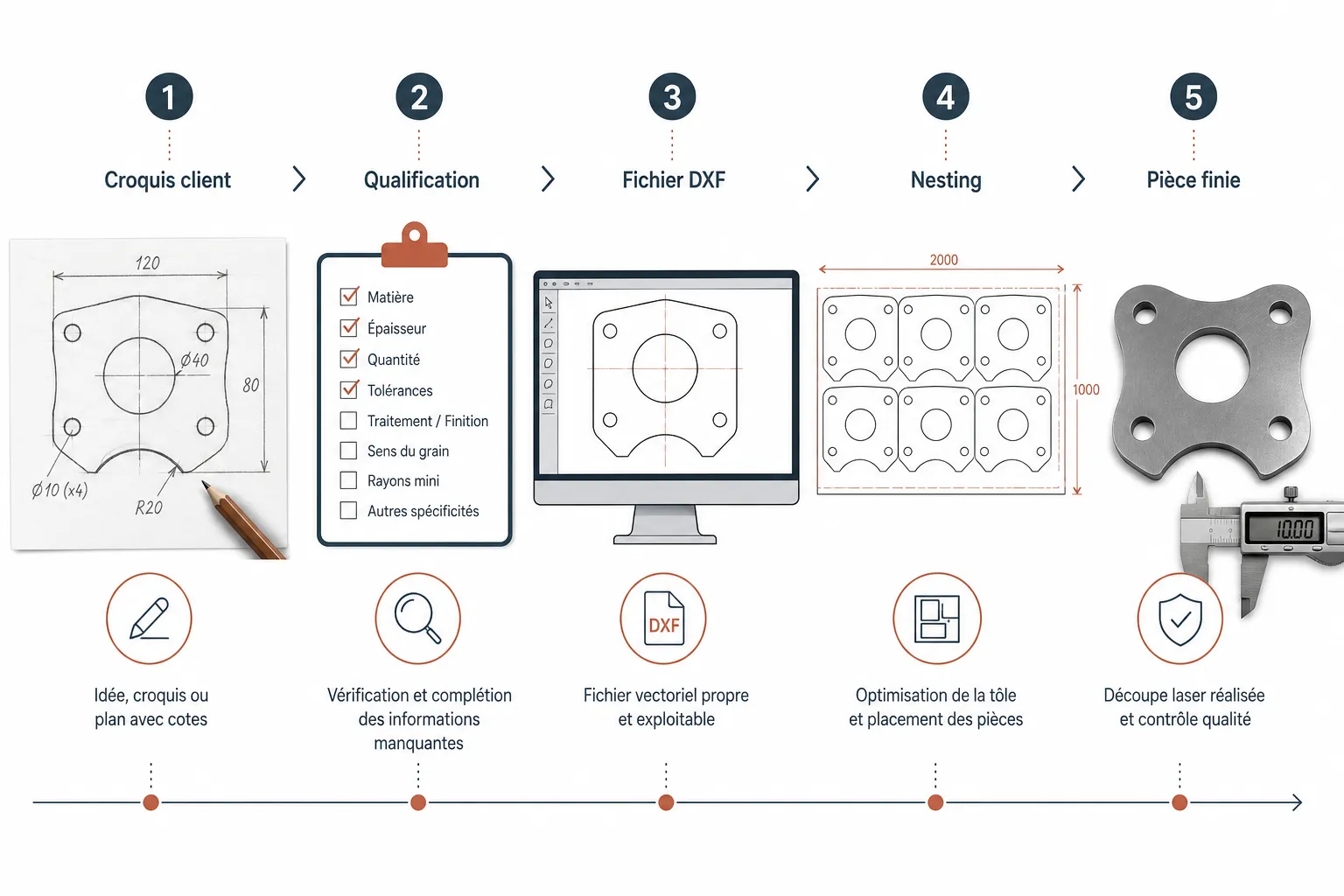
In short: in custom laser cutting the real work does not start at the machine. It starts when the customer's sketch arrives, often blurred, sometimes handwritten, always urgent. Reading that document, turning it into a usable file and producing a reliable quote is where the margin is decided. This article covers the concrete steps, the traps, and what actually wastes time on the shop floor.
What the customer calls a drawing, and what you actually receive
A customer says they are sending you "the drawing". What they send is usually a photo taken straight down onto a bench, a PDF scanned at an angle, or a torn notebook page with pencil dimensions. Sometimes both at once.
The problem is not bad will. They simply do not know what you need to start a custom laser cut. They assume you will infer the thickness, the material, the bend direction.
The classic mistake: assuming the missing information rather than calling the customer back. It feels quicker at the time. It costs a non-conformance or a remake later. Better to keep a validation checklist at the front of the quoting process, and hold to it.
The real steps between the sketch and the cut part
Here is how it goes in a serious workshop, not in a sales brochure.
Intake and qualification of the sketch: you check that every dimension is legible, that the material is stated, that the tolerances are consistent with what the machine can hold. If something is missing, you stop there, not later.
Digitising the drawing: the sketch becomes a DXF or DWG file. This is usually where time evaporates, especially if the drawing is complex or the customer forgot corner radii. A configurator that reads the sketch directly can short-circuit this step and produce the DXF automatically.
Checking machine constraints: minimum web between two cuts, minimum hole diameter relative to thickness, zones close to the edge. These rules depend on the workshop and the machine. They have to be built in before the quote, not after.
Pricing material, machine time and operator time: this is where many estimators go wrong. They calculate cutting time but forget unloading time, inspection time, offcuts. The real cost of a custom laser-cut part includes all that invisible time.
Approval and release: the file is good, the price is set, the customer approves. The part goes into production. If the digitising was done quickly and well, this step is simple. If not, this is where the back and forth starts.
The information a sketch must carry before you can price it
No serious quote without these on the customer's document.
Material and grade (304 stainless, S235 steel, 5754 aluminium and so on). Thickness in millimetres. Complete dimensions with an explicit unit. The expected tolerance if it is tight. The quantity wanted. And if the part is bent: the angles, the inside radii, the direction.
If any of these is missing, the quote is an estimate, not a price. The customer does not always understand the difference. It is the estimator's job to explain it, and to refuse to sign off a quote on an incomplete basis.
For simple parts, a well-lit, well-framed photo is sometimes enough to recover the dimensions. For complex parts with secondary machining, you need a real file. Better to say so plainly in the first exchange.
What actually slows production down
It is almost never the machine. The machine is waiting.
What slows things down is the back and forth between estimator and customer to clarify a sketch. It is the drawing redone twice because one dimension was ambiguous. It is the quote sent, approved, then reopened when the material ordered turns out to be the wrong one.
There is also the nesting problem. To optimise offcut and machine time, parts have to be nested together. If the DXF is not clean, the nesting software cannot work. You lose time cleaning curves, deleting duplicates, closing open contours.
A clean DXF coming in is often ten to twenty minutes of production saved per job. Multiplied by the number of quotes per week, that counts. The concrete workshop use cases show where those gains actually land.
My view
Custom laser cutting is a trade where the margin is made on everything around the cut, not on the cut itself. The machine is fast. What surrounds it is slow: reading the sketch, drawing it up, quoting, getting approval.
My advice: treat the front of the quoting process as a production step in its own right. Standardise what you ask the customer for. Refuse to price an incomplete sketch. And automate everything that can be automated on the drawing side, because that is where your hours disappear.
The gain does not come from a faster machine. It comes from an order-intake process that leaves nothing to chance. If you want to see how that process can be tooled on the configurator side, a demo on request takes less time than one failed drawing.
Common questions
Can a customer send a photo instead of a DXF file? Yes, for a simple part with few dimensions. For a complex part a photo creates too much ambiguity. Better to ask for a file, or use a tool that extracts the dimensions from the photo automatically.
What is the difference between quoting from a sketch and quoting from a file? From a sketch, the risk of misinterpretation is real. From a clean DXF, pricing is more reliable and the release to production is faster. A quote made from a sketch should always carry a reservation about the dimensions to be confirmed.
How do you handle a customer who changes dimensions after approving the quote? Any change after approval is a new enquiry. Put that in writing at the start of the commercial relationship, in your terms of sale. Without that rule, free amendments pile up and eat your margin.