Gaskets & rubber
References that keep coming back, pricing that does not.
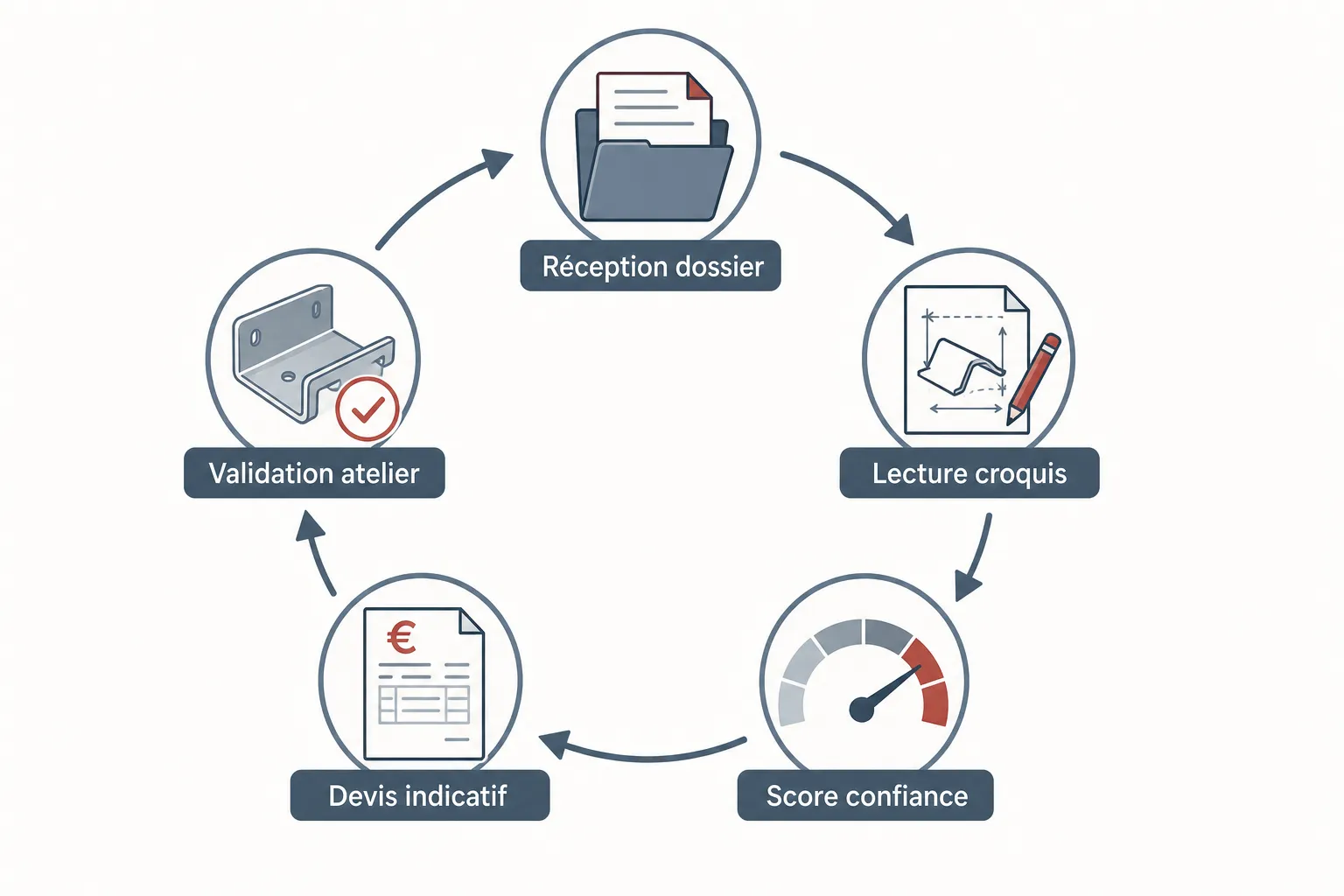
Short runs, many references, repeat enquiries: quoting gaskets costs more administrative time than machine time. Koventor recognises the enquiry, finds the reference when it already exists, and prepares the quote.
Demo with no account, fictional prices: nothing reaches a workshop.
What your customers actually send
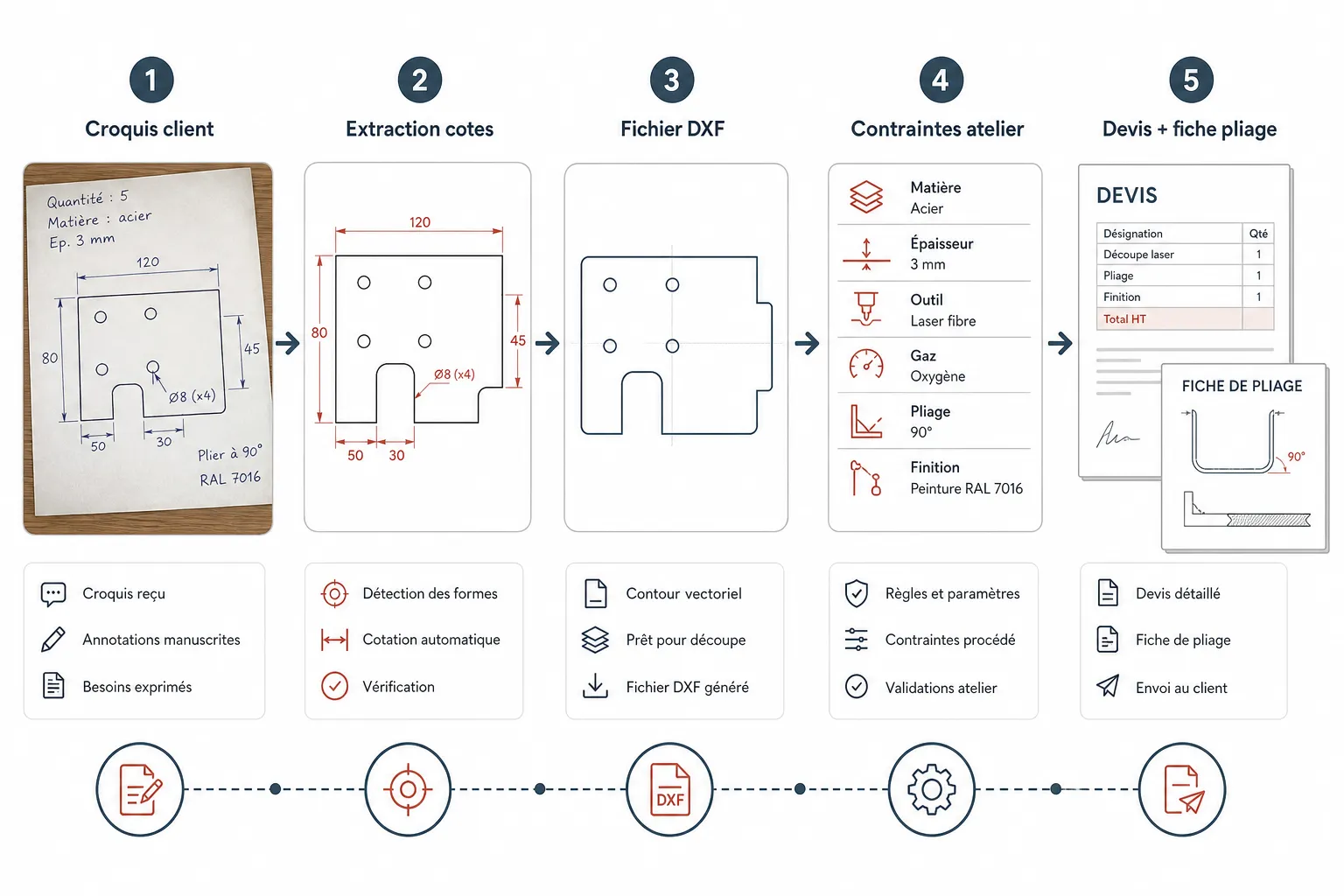
A template laid on a sheet of paper and photographed, a flange measured with callipers, an old reference to be remade identically, or a gasket drawing with its bolt hole diameter.
None of these formats is a production file. They are nevertheless what you have to price from, and that is exactly where Koventor starts.
What the pricing has to produce
The parameters specific to your trade, the ones that decide whether a price holds.
Material and hardness
NBR, EPDM, silicone, neoprene, Viton, with their Shore A hardness. The choice does not follow price but fluid, temperature and pressure: it is a technical figure before it is a cost figure.
Thickness and sheet format
The original sheet determines the nest, so the offcut, so the real price of the part. On a short run, the offcut weighs more than the material actually used.
Geometry
Outside diameter, inside diameter, bolt circle and hole count for a flange; free outline for a shaped gasket. Cutting time follows the total perimeter, holes included.
The cutting process
Waterjet, die, laser or oscillating knife: each has its own setup cost. It is that fixed cost that makes a run of five proportionally far dearer than a run of fifty.
What actually bites, and what a generic rate card ignores
The run is short, the setup is long
In this trade most of the price sits in the setup. Pricing that does not separate fixed from variable cost is wrong on every small quantity, which is to say on most enquiries.
The same part comes back constantly
An industrial customer reorders the same gasket every six months. Re-pricing it from scratch every time wastes the time twice: once preparing it, once checking you really found the same thing.
Material is chosen by constraint, not preference
A customer who asks for rubber without naming the fluid has not finished their enquiry. The tool has to ask, or the workshop carries the responsibility for the wrong choice.
150 searches a month
“custom rubber gaskets” is searched 140 times a month in the United States at $18.50 a click. Little volume, almost total purchase intent: nobody types that out of curiosity, and the click price says so.
Common questions
The customer sends a photo of a template on a sheet of paper. Is that enough?
Often yes, provided something of known size is in the frame. The system extracts the outline and asks for the reference dimension to set the scale. It is considerably more reliable than dimensions taken by hand off a worn part.
Do you handle repeat orders?
That is exactly the point: a reference already priced is found and reordered without going back through pricing. The customer gets their confirmation in minutes, you do not reopen the file.
And for a one-off?
It stays expensive, and the quote should say so plainly rather than imply a run price. Pricing that shows the setup cost avoids an unpleasant negotiation at delivery.
The other trades
What this would look like on your quotes
Try the demo for your material, then tell us about your workshop: we look at one or two of your recent quotes together and show you what the system makes of them.