Free tool
Steel plate and sheet metal weight calculator
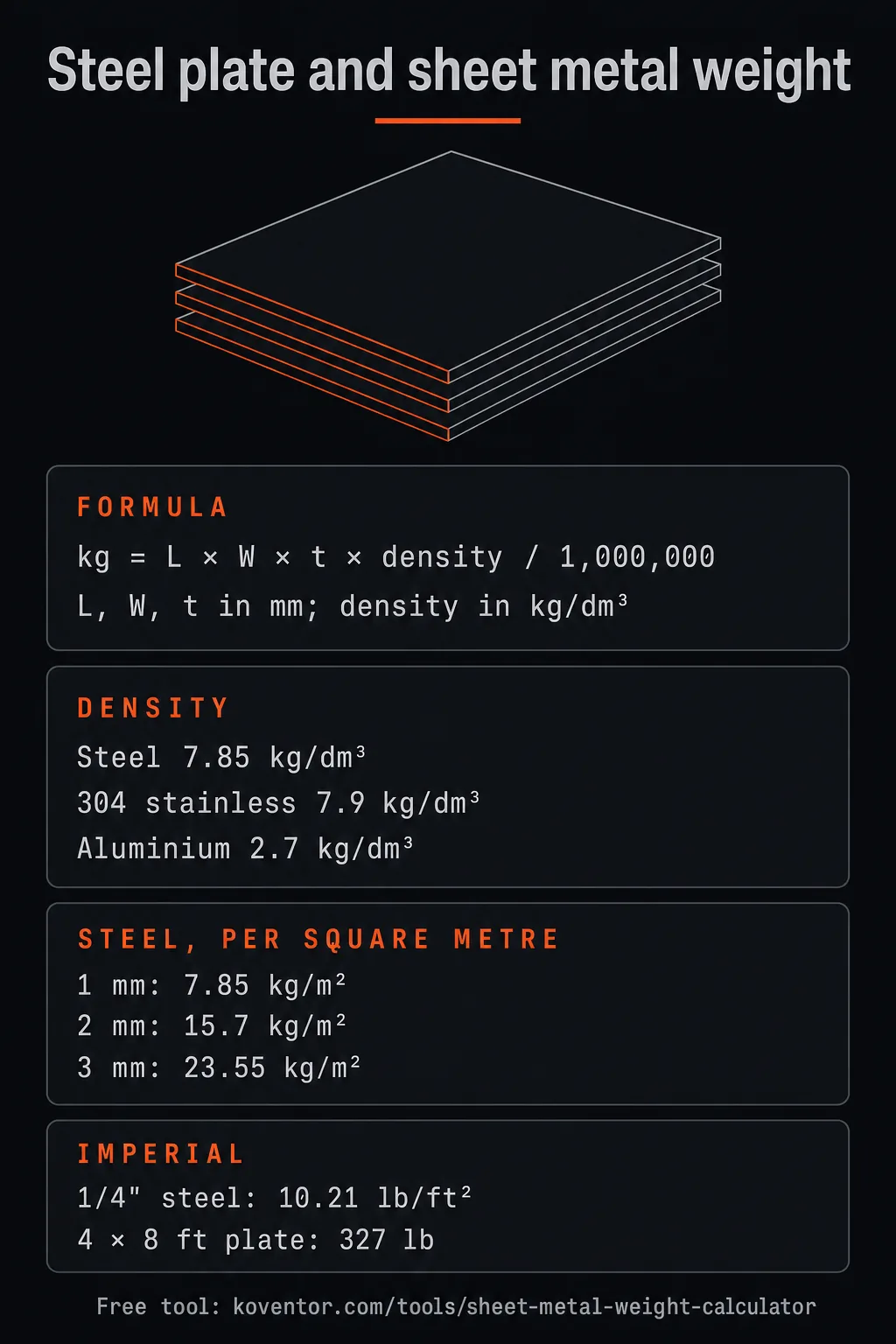
A steel sheet weighs 7.85 kg per square metre for every millimetre of thickness: 15.7 kg/m² at 2 mm, 23.55 kg/m² at 3 mm. Stainless is a little heavier, aluminium about a third. Enter your dimensions in millimetres or inches for the exact weight of a part or a batch.
Your dimensions
The weight of a parts list
Paste the rows of your spreadsheet: part number (optional), length, width, thickness in mm (the unit selected above), quantity, grade (optional, otherwise Mild steel (S235, S355, A36, DC01)). Columns separated by tabs or semicolons, up to 500 rows. Nothing leaves your browser.
My lists on this device
- No list kept yet.
My company's grades
Write its name in the grade column of the list: the row takes its density. Kept on this device.
None of this is sent to me: lists and grades stay in this browser.
Sheet weight by thickness, metric
Weight per square metre, and weight of a full mild steel sheet in the three common sizes. Calculated with the densities above.
| Thickness | Steel kg/m² | Stainless 304 kg/m² | Aluminium kg/m² | Steel 1000 × 2000 | Steel 1250 × 2500 | Steel 1500 × 3000 |
|---|---|---|---|---|---|---|
| 0.5 mm | 3.93 | 3.95 | 1.35 | 7.9 kg | 12.3 kg | 17.7 kg |
| 0.8 mm | 6.28 | 6.32 | 2.16 | 12.6 kg | 19.6 kg | 28.3 kg |
| 1 mm | 7.85 | 7.9 | 2.7 | 15.7 kg | 24.5 kg | 35.3 kg |
| 1.5 mm | 11.77 | 11.85 | 4.05 | 23.6 kg | 36.8 kg | 53 kg |
| 2 mm | 15.7 | 15.8 | 5.4 | 31.4 kg | 49.1 kg | 70.7 kg |
| 2.5 mm | 19.63 | 19.75 | 6.75 | 39.3 kg | 61.3 kg | 88.3 kg |
| 3 mm | 23.55 | 23.7 | 8.1 | 47.1 kg | 73.6 kg | 106 kg |
| 4 mm | 31.4 | 31.6 | 10.8 | 62.8 kg | 98.1 kg | 141.3 kg |
| 5 mm | 39.25 | 39.5 | 13.5 | 78.5 kg | 122.7 kg | 176.6 kg |
| 6 mm | 47.1 | 47.4 | 16.2 | 94.2 kg | 147.2 kg | 212 kg |
| 8 mm | 62.8 | 63.2 | 21.6 | 125.6 kg | 196.3 kg | 282.6 kg |
| 10 mm | 78.5 | 79 | 27 | 157 kg | 245.3 kg | 353.3 kg |
| 12 mm | 94.2 | 94.8 | 32.4 | 188.4 kg | 294.4 kg | 423.9 kg |
| 15 mm | 117.75 | 118.5 | 40.5 | 235.5 kg | 368 kg | 529.9 kg |
| 20 mm | 157 | 158 | 54 | 314 kg | 490.6 kg | 706.5 kg |
Plate weight by thickness, imperial
Weight per square foot, and weight of a 4 × 8 ft sheet (32 ft²). Same densities, converted.
| Thickness | Steel lb/ft² | Stainless 304 lb/ft² | Aluminium lb/ft² | Steel 4 × 8 ft | Aluminium 4 × 8 ft |
|---|---|---|---|---|---|
| 1/16" (1.59 mm) | 2.55 | 2.57 | 0.88 | 82 lb | 28 lb |
| 1/8" (3.18 mm) | 5.1 | 5.14 | 1.76 | 163 lb | 56 lb |
| 3/16" (4.76 mm) | 7.66 | 7.71 | 2.63 | 245 lb | 84 lb |
| 1/4" (6.35 mm) | 10.21 | 10.27 | 3.51 | 327 lb | 112 lb |
| 3/8" (9.52 mm) | 15.31 | 15.41 | 5.27 | 490 lb | 169 lb |
| 1/2" (12.7 mm) | 20.42 | 20.55 | 7.02 | 653 lb | 225 lb |
Fractional inch thicknesses only. Gauge numbers are not used here: the same gauge number gives a different thickness in steel, galvanised and aluminium.
How to calculate the weight of a sheet
weight (kg) = length × width × thickness (mm) × density (kg/dm³) / 1,000,000
Weight is volume times density. With dimensions in millimetres and a density in kg/dm³, divide by one million. Example: a 1250 × 2500 mm steel sheet, 3 mm thick. 1250 × 2500 × 3 = 9,375,000 mm³, or 9.375 dm³; times 7.85, that is 73.6 kg.
The shortcut is the weight per square metre: thickness in mm × density. Multiply it by the area in m² and you are done. In imperial units, thickness in inches × density in lb/in³ × 144 gives lb/ft².
What the weight is used for in a quote
Two lines at least. Material, when it is bought or sold by the kilo. And shipping, which is priced on weight and bundle size. On thick plate the material line often comes first, ahead of labour, which is one of the differences between heavy fabrication and precision sheet metal quoting. The Koventor configurator does both: it works out the weight of the part from its material, its thickness and its flat area, derives the bundle size, then applies your shipping method. See how the automatic price is built.
Densities used
- Mild steel (S235, S355, A36, DC01)
- 7.85 kg/dm³
- Stainless steel 304 / 304L (1.4301 / 1.4307)
- 7.9 kg/dm³
- Stainless steel 316 / 316L (1.4401 / 1.4404)
- 8 kg/dm³
- Stainless steel 321 (1.4541)
- 7.9 kg/dm³
- Ferritic stainless steel 430 (1.4016)
- 7.7 kg/dm³
- Duplex stainless steel 2205 (1.4462)
- 7.8 kg/dm³
- Aluminium, alloy not specified
- 2.7 kg/dm³
- Aluminium 1050A
- 2.71 kg/dm³
- Aluminium 3003
- 2.73 kg/dm³
- Aluminium 5005
- 2.7 kg/dm³
- Aluminium 5052
- 2.68 kg/dm³
- Aluminium 5083
- 2.65 kg/dm³
- Aluminium 5754
- 2.66 kg/dm³
- Aluminium 6061
- 2.7 kg/dm³
- Aluminium 6082
- 2.7 kg/dm³
7.85 kg/dm³: conventional density of carbon steels for theoretical mass (EN 10029:1991, EN 10365). Eurocode 1 (EN 1991-1-1, Annex A) gives 77.0 to 78.5 kN/m³.
7.9 kg/dm³, EN 10088-1, table of physical properties of stainless steels
8 kg/dm³, EN 10088-1, table of physical properties of stainless steels
7.9 kg/dm³, EN 10088-1, table of physical properties of stainless steels
7.7 kg/dm³, EN 10088-1, table of physical properties of stainless steels
7.8 kg/dm³, EN 10088-1, table of physical properties of stainless steels
2,700 kg/m³, design value of Eurocode 9 (EN 1999-1-1, clause 3.2.5), when the alloy is not known
2.71 kg/dm³, alloy data sheet (Aalco, thyssenkrupp Materials; composition to EN 573-3)
2.73 kg/dm³, alloy data sheet (Aalco, thyssenkrupp Materials; composition to EN 573-3)
2.7 kg/dm³, alloy data sheet (Aalco, thyssenkrupp Materials; composition to EN 573-3)
2.68 kg/dm³, alloy data sheet (Aalco, thyssenkrupp Materials; composition to EN 573-3)
2.65 kg/dm³, alloy data sheet (Aalco, thyssenkrupp Materials; composition to EN 573-3)
2.66 kg/dm³, alloy data sheet (Aalco, thyssenkrupp Materials; composition to EN 573-3)
2.7 kg/dm³, alloy data sheet (Aalco, thyssenkrupp Materials; composition to EN 573-3)
2.7 kg/dm³, alloy data sheet (Aalco, thyssenkrupp Materials; composition to EN 573-3)
The Koventor configurator weighs each part with 7.85 kg/dm³ for steel, 7.9 for every stainless grade and 2.7 for aluminium. A specific grade on this page can differ slightly: 1.3% for 316, 1.5% for 5754.
Method: weight (kg) = length × width × thickness (mm) × density (kg/dm³) / 1,000,000. Worked example: 1,250 × 2,500 × 3 mm of steel = 9.375 dm³ × 7.85 = 73.59 kg. Valid for a flat solid sheet at nominal thickness; perforated or checker plate needs the supplier's weight per area. Stainless densities: EN 10088-1; aluminium: alloy data sheets (Aalco, thyssenkrupp Materials); zinc coating: thyssenkrupp Steel and ArcelorMittal (Orange Book § 2.2), read on 26/11/2026.
Frequently asked questions
How much does a 2 mm steel sheet weigh?+
15.7 kg per square metre (2 × 7.85). A 1000 × 2000 mm sheet weighs 31.4 kg, a 1250 × 2500 mm sheet 49.06 kg and a 1500 × 3000 mm sheet 70.65 kg.
How much does 1/4 inch steel plate weigh per square foot?+
About 10.21 lb per square foot: 1/4" is 6.35 mm, 6.35 × 7.85 = 49.85 kg/m², and 1 kg/m² is 0.2048 lb/ft². A 4 × 8 ft plate (32 ft²) is therefore about 327 lb.
What density should I use for mild steel?+
7.85 kg/dm³, which is 7,850 kg/m³ or about 0.284 lb/in³. It is the conventional density that steel product standards use for theoretical mass (EN 10029 for hot-rolled plate, EN 10365 for sections), and the value the Koventor configurator applies. Grades such as S235, S355, A36 or DC01 do not change it at workshop accuracy: the grade changes strength and bending behaviour, not weight.
Is stainless steel heavier than mild steel?+
Slightly. 304 is 7.9 kg/dm³ and 316 is 8.0 kg/dm³ (EN 10088-1), against 7.85 for mild steel. Using 7.85 for stainless underestimates the weight by about 0.6 % for 304 and 1.9 % for 316. On one part it does not matter, on a pallet it does.
How much lighter is aluminium?+
Aluminium is 2.7 kg/dm³, roughly a third of steel (7.85 / 2.7 ≈ 2.9). A 2 mm aluminium sheet weighs 5.4 kg/m² against 15.7 kg/m² for steel. Alloys move around 2.7 a little in both directions: 2.66 for 5754, 2.68 for 5052, 2.73 for 3003 (alloy data sheets). Pick the alloy in the calculator for an exact mass.
Why does my supplier quote a different weight?+
The calculator gives a theoretical weight at nominal thickness. A real sheet has a thickness tolerance: type it (± from the mill certificate or the product standard) and the calculator gives the range of the real weight. A continuously galvanized sheet is ordered at a nominal thickness that already includes the zinc (EN 10143), so the zinc replaces a little steel instead of adding to it. When you are invoiced by real weight, the weighbridge or the mill certificate is the reference.
How do I weigh a bent part?+
Work on the flat blank, not on the folded envelope: the weight of a bent profile is the weight of the strip it was cut from, minus holes and cut-outs. The bend allowance calculator gives that flat length.
Going further
The weight, then the price, with no retyping
In Koventor the customer draws their part: the weight follows from the material, the thickness and the flat area, and shipping is worked out with it. You receive the quote, the DXF and the bend sheet.
With this free tool
- The weight of a sheet or a batch from its dimensions, in steel, stainless or aluminium.
- Weight tables by thickness, metric and imperial, and the calculation as a PDF.
With Koventor, on top
- Material is priced by the kilo or the square metre, with your rates, on every quote.
- Parts are interlocked by rotation to get the most out of the sheet.
- Once the customer approves, you receive the cut-ready DXF and the bending sheet.