Free tool
Press brake tonnage calculator for air bending
Enter the material, the thickness and the bend length: the calculator gives the force in US tons and tonnes, per foot and per metre, with the V die it assumes, the inside radius it produces and the minimum edge it needs. Add your press capacity to see how much of it the bend uses.
Force needed
14.7 US tons
- Per foot
- 3.68 US tons
- Per metre
- 10.95 tonnes
- Total
- 13.35 tonnes, 131 kN
- V die (recommended)
- 0.480 in
- Inside radius produced
- 0.077 in
- Minimum edge
- 0.300 in
Radius: 0.16 × V is the mild steel rule. Published order of magnitude for this material: 15 to 17 % of V (The Fabricator).
Air bending. Bottoming needs about three to five times this force, coining five to ten times or more. Most presses do not deliver their rated tonnage across the whole bed: check the capacity at the length you bend.
Free, kept on this device
Your press brakes: the capacity chart
Enter each press once: tonnage, bending length, dies, materials. The chart gives, for each thickness and each die, the force per unit length and the length the press can bend at its rated tonnage. Then you check one bend with a few numbers, in inches and US tons or in millimetres and tonnes.
Press brake tonnage chart, mild steel (s235)
Recommended V (8 × t), Rm = 400 N/mm². Gauges of the matching series, from the sheet metal gauge chart.
| Thickness | V die | Inside radius | Min. edge | US tons / ft | Tonnes / m |
|---|---|---|---|---|---|
| 7 ga (0.1793 in) | 1.433 in | 0.229 in | 0.896 in | 11.09 | 33.0 |
| 8 ga (0.1644 in) | 1.315 in | 0.210 in | 0.822 in | 10.16 | 30.2 |
| 9 ga (0.1495 in) | 1.197 in | 0.191 in | 0.748 in | 9.23 | 27.5 |
| 10 ga (0.1345 in) | 1.075 in | 0.172 in | 0.672 in | 8.32 | 24.8 |
| 11 ga (0.1196 in) | 0.957 in | 0.153 in | 0.598 in | 7.39 | 22.0 |
| 12 ga (0.1046 in) | 0.839 in | 0.134 in | 0.524 in | 6.45 | 19.2 |
| 13 ga (0.0897 in) | 0.717 in | 0.115 in | 0.448 in | 5.55 | 16.5 |
| 14 ga (0.0747 in) | 0.598 in | 0.096 in | 0.374 in | 4.61 | 13.7 |
| 15 ga (0.0673 in) | 0.539 in | 0.086 in | 0.337 in | 4.15 | 12.3 |
| 16 ga (0.0598 in) | 0.480 in | 0.077 in | 0.300 in | 3.68 | 10.9 |
| 17 ga (0.0538 in) | 0.429 in | 0.069 in | 0.268 in | 3.33 | 9.9 |
| 18 ga (0.0478 in) | 0.382 in | 0.061 in | 0.239 in | 2.96 | 8.8 |
| 19 ga (0.0418 in) | 0.335 in | 0.054 in | 0.209 in | 2.58 | 7.7 |
| 20 ga (0.0359 in) | 0.287 in | 0.046 in | 0.180 in | 2.22 | 6.6 |
| 21 ga (0.0329 in) | 0.264 in | 0.042 in | 0.165 in | 2.03 | 6.0 |
| 22 ga (0.0299 in) | 0.240 in | 0.038 in | 0.150 in | 1.84 | 5.5 |
| 23 ga (0.0269 in) | 0.217 in | 0.035 in | 0.135 in | 1.65 | 4.9 |
| 24 ga (0.0239 in) | 0.193 in | 0.031 in | 0.120 in | 1.46 | 4.4 |
The formulas
- Force per mm of bend
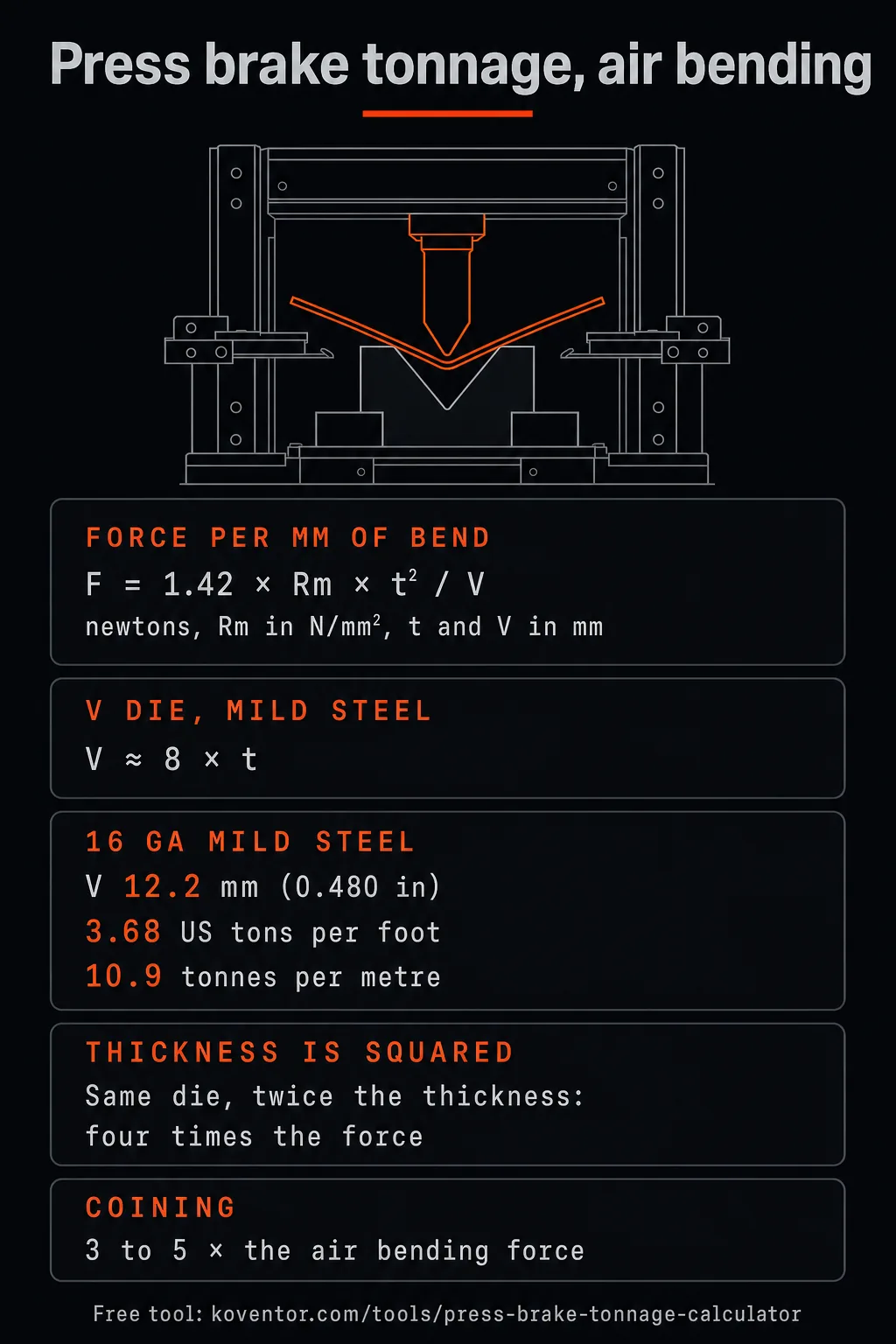
- F ≈ 1.42 × Rm × t² / V
- V die opening
- V ≈ 8 × t
- Inside radius
- Ri ≈ 0.16 × V
- Minimum edge
- ≈ V / 2 + t
F in newtons per millimetre, Rm in N/mm², t and V in millimetres. The calculator converts inches for you.
Frequently asked questions
How do you calculate press brake tonnage?+
For air bending, the force per millimetre of bend length is about 1.42 × Rm × t² / V, in newtons, with Rm the tensile strength in N/mm², t the thickness and V the die opening in millimetres. Multiply by the bend length, then divide by 9,810 for tonnes or by 8,896 for US tons. 1.42 is an empirical coefficient commonly used on the shop floor.
Why does thickness change the tonnage so much?+
It is squared in the formula. Going from 2 to 4 mm on the same die does not double the force, it quadruples it. That is how a press that handled the previous run without trouble stalls on the next one.
What V die opening should I use?+
The usual shop rule is about 8 times the thickness for mild steel, 9 times for S355 and 304 stainless, 6 times for 5754 aluminium. A narrower V gives a tighter radius but needs more force and marks the material more; a wider V does the opposite. In air bending the inside radius follows from the V: about 0.16 × V.
What is the minimum flange length for a V die?+
About half the V plus the thickness. Below that the sheet no longer sits on both shoulders of the die: it slides in instead of bending. On a 16 mm V with 2 mm sheet, allow about 10 mm.
How much more force does coining need?+
Much more. Published shop figures put bottoming at about three to five times the air bending force (Bystronic says five or more) and coining at five to ten times or more (Bystronic: ten or more). The formula on this page is for air bending only: a tight angle tolerance that forces bottoming or coining can make a part unmakeable on a press that bent it fine in air.
How many tons does it take to bend 16 gauge steel?+
16 gauge standard steel is 1.52 mm thick. With a 12.2 mm V (8 × t) and Rm = 400 N/mm², it takes about 3.68 US tons per foot, so about 36.8 US tons for a 10 ft bend.
Does a press deliver its rated tonnage over the whole bed?+
Most presses do not: past a certain span the bed deflects and the angle varies from one end of the bend to the other. Check the capacity your press is rated for at the length you bend, not only its nameplate tonnage.
Going further
Your presses, your dies, checked before the quote
Koventor knows your presses, your dies and your materials. A part whose tonnage exceeds your capacity is flagged at entry, with the V that would make it feasible.
With this free tool
- The force for one bend, per foot and per metre, with the V die, inside radius and minimum edge that go with it.
- A check against your press capacity, and the result as a PDF.
With Koventor, on top
- Koventor knows your presses, your dies and your materials.
- A part whose tonnage exceeds your capacity is flagged at entry, with the V that would make it feasible.
- The bending sheet gives the setter the bend order, dimensions and angles.