Free tool
Sheet metal gauge chart: gauge to inches and millimetres
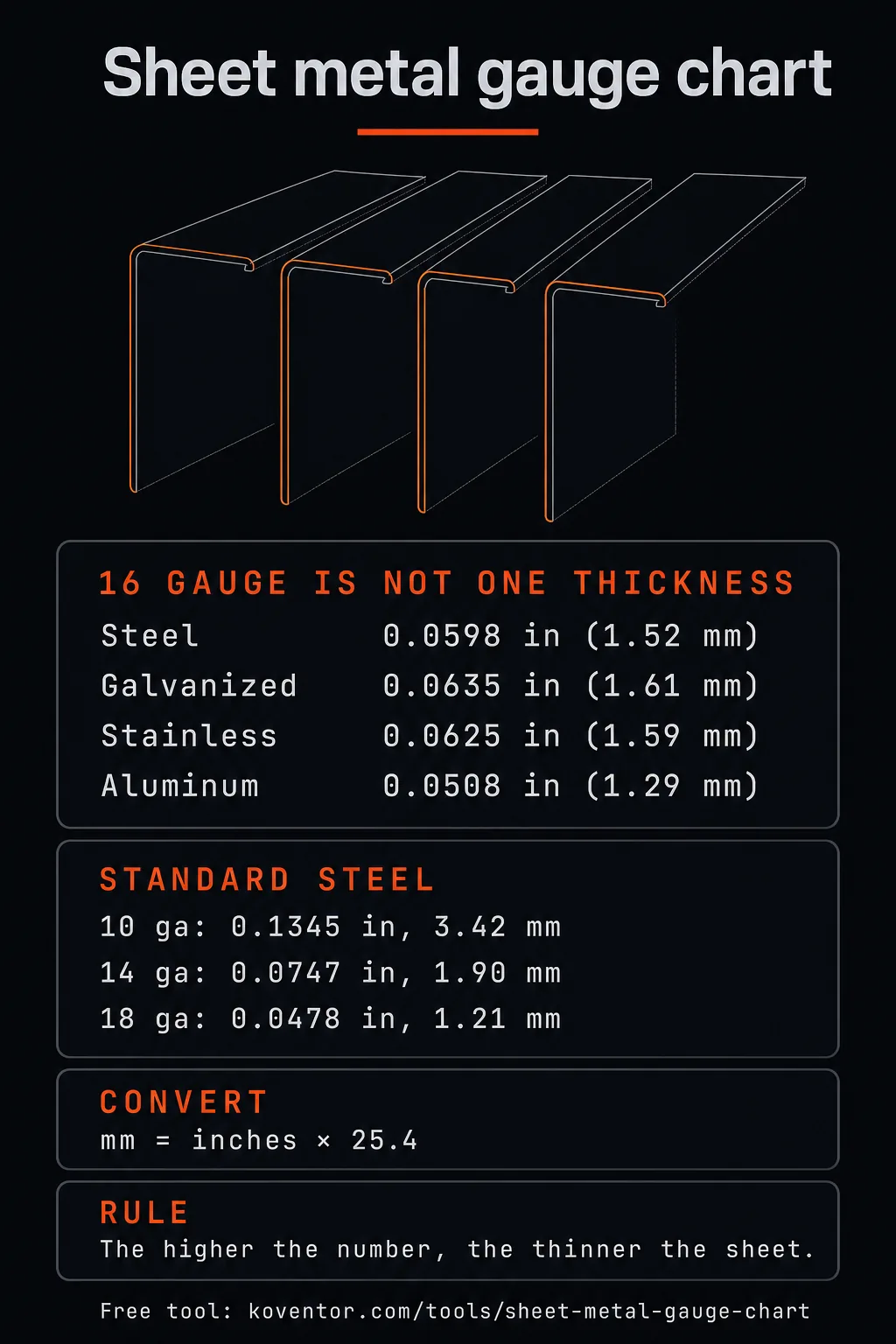
A gauge number is not a thickness. 16 gauge is 0.0598 in in standard steel, 0.0625 in in stainless and 0.0508 in in aluminum. Read the chart for your material, or type a thickness to find the nearest gauge in each series.
Gauge to thickness
- Standard steel
- 0.0598 in, 1.52 mm
- Galvanized steel
- 0.0635 in, 1.61 mm
- Stainless steel
- 0.0625 in, 1.59 mm
- Aluminum
- 0.0508 in, 1.29 mm
Thickness to the nearest gauge
- Standard steel
- 16 gauge (0.0598 in, +0.02 mm)
- Galvanized steel
- 17 gauge (0.0575 in, −0.04 mm)
- Stainless steel
- 17 gauge (0.0563 in, −0.07 mm)
- Aluminum
- 15 gauge (0.0571 in, −0.05 mm)
Sheet metal gauge chart, inches and millimetres
| Gauge | Standard steelManufacturers' Standard Gauge | Galvanized steelGalvanized Sheet Gauge | Stainless steelU.S. Standard Gauge | AluminumBrown & Sharpe (AWG) | ||||
|---|---|---|---|---|---|---|---|---|
| in | mm | in | mm | in | mm | in | mm | |
| 3 | 0.2391 | 6.07 | - | - | - | - | - | - |
| 4 | 0.2242 | 5.69 | - | - | - | - | - | - |
| 5 | 0.2092 | 5.31 | - | - | - | - | - | - |
| 6 | 0.1943 | 4.94 | - | - | - | - | 0.1620 | 4.12 |
| 7 | 0.1793 | 4.55 | - | - | 0.1875 | 4.76 | 0.1443 | 3.66 |
| 8 | 0.1644 | 4.18 | 0.1681 | 4.27 | 0.1719 | 4.37 | 0.1285 | 3.26 |
| 9 | 0.1495 | 3.80 | 0.1532 | 3.89 | 0.1563 | 3.97 | 0.1144 | 2.91 |
| 10 | 0.1345 | 3.42 | 0.1382 | 3.51 | 0.1406 | 3.57 | 0.1019 | 2.59 |
| 11 | 0.1196 | 3.04 | 0.1233 | 3.13 | 0.1250 | 3.17 | 0.0907 | 2.30 |
| 12 | 0.1046 | 2.66 | 0.1084 | 2.75 | 0.1094 | 2.78 | 0.0808 | 2.05 |
| 13 | 0.0897 | 2.28 | 0.0934 | 2.37 | 0.0938 | 2.38 | 0.0720 | 1.83 |
| 14 | 0.0747 | 1.90 | 0.0785 | 1.99 | 0.0781 | 1.98 | 0.0641 | 1.63 |
| 15 | 0.0673 | 1.71 | 0.0710 | 1.80 | 0.0703 | 1.79 | 0.0571 | 1.45 |
| 16 | 0.0598 | 1.52 | 0.0635 | 1.61 | 0.0625 | 1.59 | 0.0508 | 1.29 |
| 17 | 0.0538 | 1.37 | 0.0575 | 1.46 | 0.0563 | 1.43 | 0.0453 | 1.15 |
| 18 | 0.0478 | 1.21 | 0.0516 | 1.31 | 0.0500 | 1.27 | 0.0403 | 1.02 |
| 19 | 0.0418 | 1.06 | 0.0456 | 1.16 | 0.0437 | 1.11 | 0.0359 | 0.91 |
| 20 | 0.0359 | 0.91 | 0.0396 | 1.01 | 0.0375 | 0.95 | 0.0320 | 0.81 |
| 21 | 0.0329 | 0.84 | 0.0366 | 0.93 | 0.0344 | 0.87 | 0.0285 | 0.72 |
| 22 | 0.0299 | 0.76 | 0.0336 | 0.85 | 0.0313 | 0.79 | 0.0254 | 0.64 |
| 23 | 0.0269 | 0.68 | 0.0306 | 0.78 | 0.0281 | 0.71 | 0.0226 | 0.57 |
| 24 | 0.0239 | 0.61 | 0.0276 | 0.70 | 0.0250 | 0.64 | 0.0201 | 0.51 |
| 25 | 0.0209 | 0.53 | 0.0247 | 0.63 | 0.0219 | 0.56 | 0.0179 | 0.45 |
| 26 | 0.0179 | 0.45 | 0.0217 | 0.55 | 0.0187 | 0.48 | 0.0159 | 0.40 |
| 27 | 0.0164 | 0.42 | 0.0202 | 0.51 | 0.0172 | 0.44 | 0.0142 | 0.36 |
| 28 | 0.0149 | 0.38 | 0.0187 | 0.47 | 0.0156 | 0.40 | 0.0126 | 0.32 |
| 29 | 0.0135 | 0.34 | 0.0172 | 0.44 | 0.0141 | 0.36 | 0.0113 | 0.29 |
| 30 | 0.0120 | 0.30 | 0.0157 | 0.40 | 0.0125 | 0.32 | 0.0100 | 0.25 |
| 31 | 0.0105 | 0.27 | 0.0142 | 0.36 | - | - | - | - |
| 32 | 0.0097 | 0.25 | - | - | - | - | - | - |
| 33 | 0.0090 | 0.23 | - | - | - | - | - | - |
| 34 | 0.0082 | 0.21 | - | - | - | - | - | - |
| 35 | 0.0075 | 0.19 | - | - | - | - | - | - |
| 36 | 0.0067 | 0.17 | - | - | - | - | - | - |
| 37 | 0.0064 | 0.16 | - | - | - | - | - | - |
| 38 | 0.0060 | 0.15 | - | - | - | - | - | - |
Nominal thicknesses: mills deliver within a tolerance. A dash means the series has no gauge there, or that the sources disagree.
Where these values come from
Each value appears identically in two published sources, cross-checked on 24 November 2026. A gauge that only one source lists, or where they disagree, is left out rather than guessed.
- Standard steel: Manufacturers' Standard Gauge for sheet steel, from Machinery's Handbook as tabulated in the Wikipedia article on sheet metal, identical in the Engineers Edge gauge table and, from 7 to 30 gauge, in the Metal Supermarkets gauge chart.
- Galvanized steel: Galvanized Sheet Gauge, the same sources. Every value is the standard steel value plus 0.0037 in.
- Stainless steel: the U.S. Standard Gauge for sheet and plate iron and steel, set by 15 U.S.C. § 206, as listed for stainless sheet in the Metal Supermarkets chart. Odd gauges above 11 are left out.
- Aluminum: the Brown & Sharpe series (American Wire Gauge), d = 0.005 in × 92^((36 − n) / 39), as listed in the Metal Supermarkets chart and the Brown & Sharpe column of Engineers Edge.
Frequently asked questions
What is sheet metal gauge?+
A number that stands for a thickness within a given series. The higher the number, the thinner the sheet. Each material has its own series, which is why the same gauge gives a different thickness in steel, stainless and aluminum.
How thick is 16 gauge?+
In standard steel, 16 gauge is 0.0598 in (1.52 mm). Galvanized 16 gauge is 0.0635 in, stainless 0.0625 in (1.59 mm) and aluminum 0.0508 in (1.29 mm).
How do I convert gauge to mm?+
Find the gauge in the series of your material, then multiply the thickness in inches by 25.4. There is no single formula that works across materials. Aluminum is the exception that has one: the Brown & Sharpe series, d = 0.005 in × 92^((36 − n) / 39).
Why is galvanized steel thicker than standard steel at the same gauge?+
The galvanized series includes the zinc coating. In this chart every galvanized value is 0.0037 in above the standard steel value of the same gauge.
Which gauge series does stainless steel use?+
In this chart, the U.S. Standard Gauge for sheet and plate iron and steel (15 U.S.C. § 206), the series the supplier chart we checked uses for stainless sheet. Confirm the decimal thickness with your supplier before you order.
Should I order sheet metal by gauge or by thickness?+
By decimal thickness, in inches or millimetres, with its tolerance. A gauge number means nothing without its series, and two people can read the same gauge as two different sheets.
How much does a sheet of a given gauge weigh?+
Take the thickness from the chart and enter it in the sheet metal weight calculator: it gives the weight of one sheet and of a batch, in kg and lb, for steel, stainless and aluminum.
Going further
Thicknesses, materials and your constraints, on every quote
Koventor applies your shop's constraints to every part your customers configure, prices the material with your rates, and sends you the cut-ready DXF and the bending sheet.
With this free tool
- Gauge to inches and millimetres for standard steel, galvanized, stainless and aluminum.
- The nearest gauge for any thickness, and the chart as a PDF.
With Koventor, on top
- Your shop's constraints are applied to every part before the quote goes out.
- Material is priced by the kilo or the square metre, with your rates.
- Once the customer approves, you receive the cut-ready DXF and the bending sheet.