Free tool
Sheet metal cost estimator: price a part with your own rates
Material, cutting time, pierces, bends, press setup and finish, then your margin. Every rate on this page is yours to type: the values it opens with are examples, not market prices.
Selling price per part
$5.15
Batch of 50: $257.50
- Material (1.628 lb)
- $1.12
- Cutting (0.51 min)
- $1.29
- Bending (0.67 min)
- $1.00
- Setup share
- $0.45
- Finish
- $0.00
- Cost per part
- $3.86
- Margin (25 % of the selling price)
- $1.29
- Margin on price / markup on cost
- 25.0 % / 33.3 %
Estimate from your rates. It does not replace a quote, and real nesting depends on the whole order.
Pricing simulator
The part above priced at several quantities, with labour and fixed costs per batch, its break-even quantity, and other parts compared on the same rates. These are estimates with your rates, never a firm price. Nothing is sent.
| Quantity | Cost per part | of which fixed | Price per part | Batch price |
|---|---|---|---|---|
| 1 | $25.9103 | $22.5000 | $34.55 | $34.55 |
| 10 | $5.6603 | $2.2500 | $7.55 | $75.50 |
| 50quantity above | $3.8603 | $0.4500 | $5.15 | $257.50 |
| 100 | $3.6353 | $0.2250 | $4.85 | $485.00 |
| 500 | $3.4553 | $0.0450 | $4.61 | $2,305.00 |
Break-even quantity
…
Parts compared
Your rates on this device
Kept in this browser only: nothing is sent to me. They are there for your next visit, on this device.
Extra, in exchange for your email
Your pricing simulator, as an Excel workbook
The calculation above as a workbook you reuse for every quote: your rates on one sheet, your parts in formulas, the price for each quantity and the break-even of a target price.
What the file contains
- 5 sheets: parts, rates, quantities, break-even, method
- Your rates on one sheet: change an hourly rate or a material price and every price follows
- 1 part in formulas: material, cutting, bending, labour, fixed share, price per part and batch price
- The price of each part for 5 quantities, and the break-even quantity of a target price
How to calculate the cost of a sheet metal part
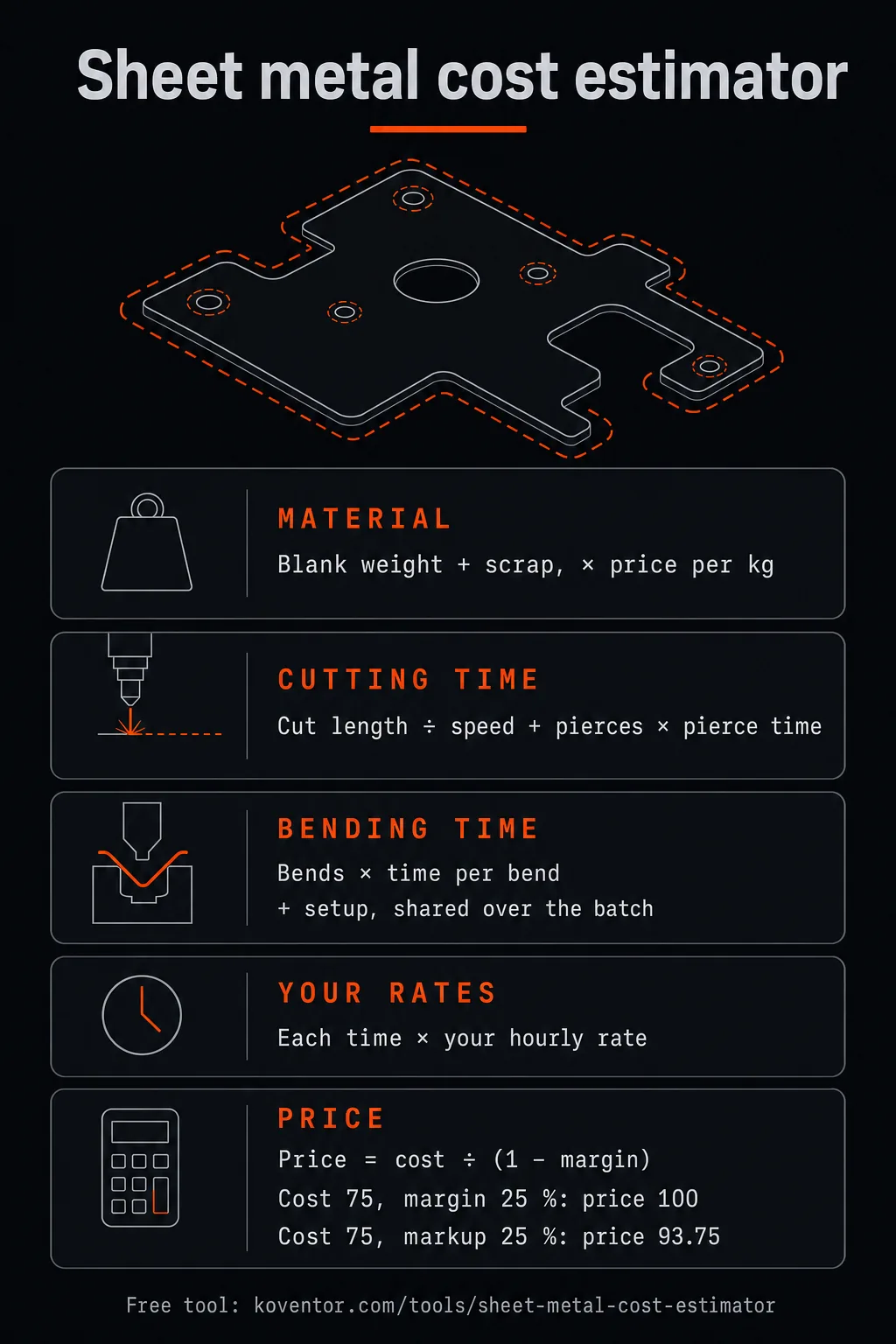
Five lines make the cost, then the margin makes the price. These are the formulas the estimator above runs, with the rates you type.
Material
blank weight × (1 + scrap %) × price per lb or kg
The blank weight is length × width × thickness × density, before any hole is cut.
Cutting
(cut length ÷ speed + pierces × pierce time) × laser hourly rate
One pierce per closed contour: the outline, plus one for each hole.
Bending
bends × time per bend × press brake hourly rate
Time per bend in seconds, rate per hour: the estimator does the conversion.
Setup
setup time × press brake hourly rate ÷ quantity
Counted only when the part has bends. It costs the same for 5 parts as for 500, so it weighs most on small runs.
Cost
material + cutting + bending + setup + finish
Finish is entered as a price per part.
Price
cost ÷ (1 − margin), or cost × (1 + markup)
Pick the convention: a margin is a share of the selling price, 25 % on a cost of 75 gives 100, where a 25 % markup on cost gives 93.75. The estimator shows both rates.
What a 4 × 8 ft sheet costs
A 4 × 8 ft sheet is 32 ft². Bought by weight, it costs its weight times your price per pound, and its price per square foot is the weight per square foot times the same price. The weights below come from the densities of the sheet metal weight calculator; the price is yours.
| Thickness | Steel lb/ft² | Steel 4 × 8 ft | Aluminium lb/ft² | Aluminium 4 × 8 ft |
|---|---|---|---|---|
| 1/16" (1.59 mm) | 2.55 | 82 lb | 0.88 | 28 lb |
| 1/8" (3.18 mm) | 5.1 | 163 lb | 1.76 | 56 lb |
| 3/16" (4.76 mm) | 7.66 | 245 lb | 2.63 | 84 lb |
| 1/4" (6.35 mm) | 10.21 | 327 lb | 3.51 | 112 lb |
| 3/8" (9.52 mm) | 15.31 | 490 lb | 5.27 | 169 lb |
| 1/2" (12.7 mm) | 20.42 | 653 lb | 7.02 | 225 lb |
Theoretical weights at nominal thickness: steel 7.85 kg/dm³ (Eurocode 3), aluminium 2.7 kg/dm³ (Eurocode 9). Multiply by your price per pound.
Frequently asked questions
How do you estimate the cost of a sheet metal part?+
Line by line: the material of the blank with its scrap, the cutting time (cut length over speed, plus the time of each pierce), the bending time, the press setup shared over the batch and the finish. That gives the cost. The selling price adds your margin on top.
Which rates should I use?+
Your own: what you pay for the material, and the hourly rate of each machine as your accounts give it. The values shown when the page opens are examples to replace, not market prices.
What is the difference between margin and markup?+
Here the margin is a share of the selling price: price = cost / (1 − margin). A 25 % margin on a 75 cost gives a price of 100. The same 25 added as a markup on the cost would give 93.75.
How do I get the cut length of a real part?+
Open its DXF in the free DXF viewer: it measures the total cut length and counts the closed contours, which are your pierces, then opens this estimator with both values filled in.
Does the estimate account for nesting?+
Only through the scrap percentage, applied to the blank weight. Real nesting depends on the whole order and on how the parts are laid on the sheet.
How do I compare quantities or several parts?+
With the simulator below the estimator: it takes your part and your rates, gives the price for each quantity, adds labour and fixed costs per batch if you need them, works out from how many parts a target price covers the cost, and compares other parts on the same rates. Your rates can stay saved on your device for your next visit.
Why include the setup time?+
Setting up the press brake costs the same for 5 parts as for 500. Shared over a small batch it can weigh more than the bending itself: try a quantity of 1, then 100.
Going further
Your rates, on every part your customers configure
In Koventor the price is built line by line on your rates: material by the kilo or the square metre, machine time, holes, finish, freight and margin. The part arrives priced and you only approve it.
With this free tool
- The cost of one part from your rates: material, cutting, bending, setup and finish, then your margin.
- The breakdown as a PDF, and a link to reopen it.
With Koventor, on top
- The same build runs on every part your customers configure: material by the kilo or the square metre, machine time, holes, finish, freight and margin.
- Freight is worked out with the weight and the bundle size.
- Parts are interlocked by rotation to get the most out of the sheet.
- A customer who calls gets the same price from the counter mode, no drawing needed.