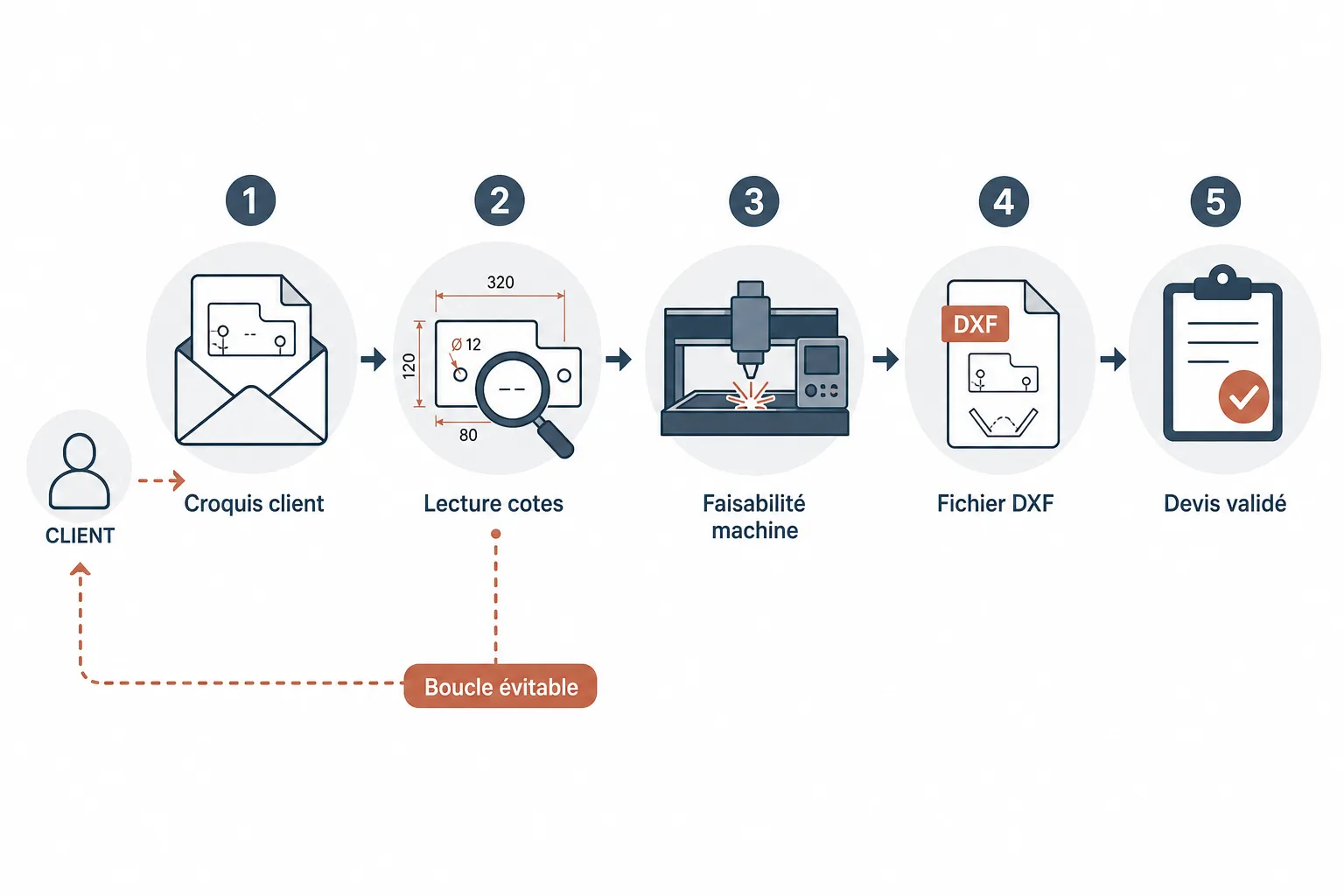
In short: a workshop can answer a custom sheet metal enquiry quickly without tying up its drawing office, provided it structures how customer sketches are read and automates what can be automated. Here is how, concretely.
Why custom sheet metal slows the estimator down
The customer sends a hand sketch, sometimes a blurred scan, sometimes a PDF of a drawing made in some proprietary software. The estimator has to read it, understand the dimensions, check feasibility, then price it. Unaided, twenty minutes disappear on a simple part.
The real problem is not the time per part. It is the accumulation. Three enquiries at once on a Monday morning and the drawing office is saturated before production has even started.
And when the office is busy on a live project, quotes wait. The customer does not wait forever. They call the competitor.
What a customer sketch really contains, and where it jams
A customer sketch for custom sheet metal rarely contains what it should. Dimensions are missing, tolerances are absent, the material is written as "stainless" with no thickness and no grade.
Reading the sketch is the first source of error in a sheet metal quote. Not the calculation, not the material price. The reading.
The points that jam most often:
- Telling outside dimensions from inside dimensions on bends
- Bend radii not stated
- Shapes with nested cut-outs badly positioned
- Views that do not agree (a front view inconsistent with the side view)
When something is unclear, the estimator has to call. That takes time, it creates round trips, and sometimes the customer cannot answer either.
Reading fast and reading right
The first thing to do is define a standard intake format. Not to impose a constraint on the customer, but to guide what they send. An enquiry template online, a checklist PDF attached to the automatic contact reply: that filters out a good share of the vagueness.
Then separate the roles. The estimator reads the sketch and confirms feasibility. The drawing office only steps in when the part is genuinely complex. Most custom cutting enquiries are standard parts: rectangles, Ls, Us, simple shapes with a few holes.
Reserving the drawing office for genuinely complex parts is what protects production capacity. The rest should be handled by the estimator alone, with the right tools.
For workshops handling real volume, automating the sketch reading is the logical next step. That is what configurators do when they read the incoming file and produce a DXF and a bend sheet directly. See how other workshops structured that flow in the use cases.
The classic mistakes that cost money
The first mistake: quoting too fast without confirming the material. The customer says "steel", the estimator prices S235, and the part ends up in 316L stainless because it is a food application. The price bears no relation.
The second: not building nesting into the quote. When the part nests badly in the standard sheet format, material is lost. That loss has a real cost. Failing to pass it on cuts straight into the margin.
Never send a quote without checking that the dimensions allow the minimum edge distances your machine can hold. It is the most frequent fault on parts with holes near the edges.
The third mistake: accepting an illegible sketch so as not to offend the customer, then having to redo everything once the part is released. A courteous refusal with a request for clarification beats a non-conformance.
Organising the quoting flow without overloading the team
An efficient flow looks like this: sketch arrives, dimensions read automatically or manually, feasibility checked, DXF generated, price approved, quote sent. Each step needs an owner and an internal deadline.
The critical point is the handover between arrival and reading. If the sketch sits in a shared mailbox with nobody assigned, it will sit there. Naming one person who triages incoming enquiries each morning changes everything.
For workshops with repeat customers, keeping a sheet per customer with their usual materials, their tolerances, their preferred sheet formats halves the reading time on repeat orders.
The time saved on custom sheet metal does not come from going faster, it comes from eliminating pointless round trips. It is structural, not a question of individual speed. To see how a configurator automates that flow from sketch to quote, the approach is set out on the Koventor home page.
My view
Most workshops I meet are not short of work. They are short of time to answer incoming enquiries quickly without blocking production.
My advice: before investing in anything, map where the time actually goes on your custom cutting quotes. Is it reading the sketch? The round trips with the customer? Checking machine feasibility? The answer changes everything.
If most of the time goes to reading and interpreting unclear sketches, that is where to act first. Not on PDF generation, not on how the quote looks.
Common questions
Can you quote custom cutting without a DXF? Yes. A good dimensioned sketch is enough if every dimension is legible and the materials are stated. A DXF speeds up release to production, but it is not essential at the quoting stage.
How do you handle a customer who sends an incomplete drawing? Ask for what is missing before pricing, never after. A precise list of questions (thickness, material, tolerances, quantity) sent immediately reads as professional. It does not slow the customer down, it reassures them.
Do you need a drawing office for every custom-cut part? No. Simple parts, rectangular or with few cut-outs, can be handled directly by an estimator trained to read drawings. The drawing office should stay available for parts with complex geometry, tight tolerances or particular assembly constraints.