A quote goes out, a week passes, and nothing. You priced the part, produced a cutting layout, estimated the material — and the customer doesn't reply. No yes, no no. Just silence. In a sheet metal or laser cutting shop, this scenario repeats itself dozens of times a month. Dormant quotes pile up, no one has time to follow up on them one by one, and part of that sales work ends up in the trash. This article explains concretely how to automate these follow-ups without pressuring the customer, without promising the moon, and without taking the human out of the loop.
Why do unanswered quotes cost as much as an idle machine?
A quote represents real time: reading the drawing, calculating material consumption, estimating clamping time, checking tolerances. When that work leads to nothing, it's not just a lost sale — it's a cost absorbed with no return. In a shop where margins are tight and the order book is cyclical, leaving quotes unfollowed means letting potential revenue go cold without reacting.
Most shop owners know this. The problem isn't awareness of the phenomenon, it's time. Following up manually on each quote — finding the right contact, retrieving the right amount, choosing the right moment — takes a sales organization that many 5-to-30-person shops simply don't have. The production manager can't play inside sales rep between two CNC programs.
That's exactly why an automated follow-up, well configured, changes the game. Not because it replaces human judgment, but because it does the mechanical work — sending a message at the right time, to the right recipient, with the right quote in reference — without you having to think about it.
Concretely, how does an automatic follow-up on a dormant quote work?
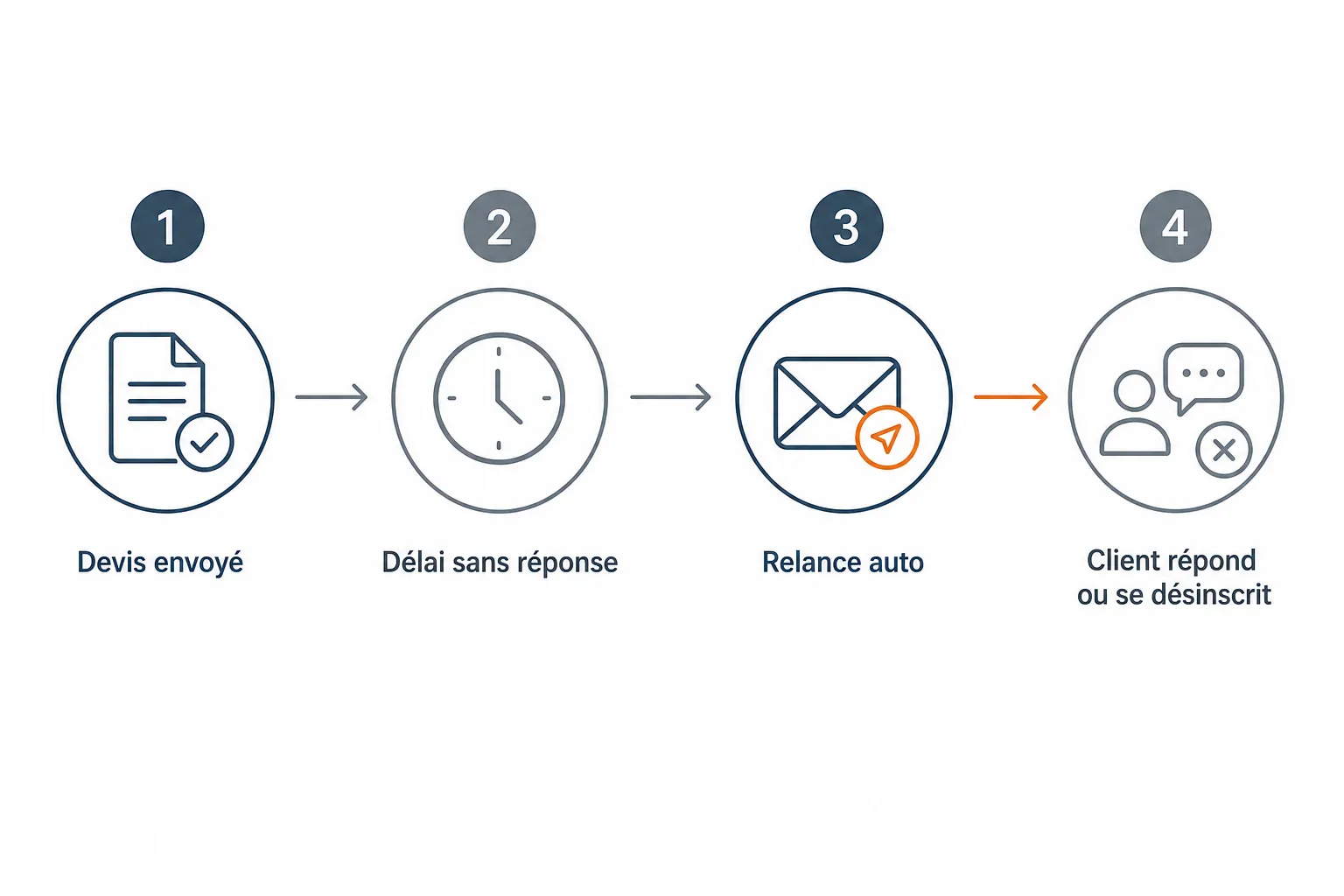
The principle is simple: as soon as a quote passes a certain delay without a reply — three days, five days, a week, depending on what you define — the system automatically sends the customer a message reminding them the proposal is pending. This message isn't an aggressive follow-up. It's a short, neutral touch that reopens the conversation without applying pressure.
At Koventor, automatic follow-up is part of the request processing flow. When a customer has received an indicative quote — that is, a first estimate generated from their sketch or file, then confirmed by your shop — and doesn't follow up, a reminder goes out automatically. The message mentions the quote in question, recaps the main points, and invites the customer to reply directly or ask a question.
What's important to understand: the system doesn't follow up forever. It stops if the customer replies, if the quote is accepted, or if the customer unsubscribes. This unsubscribe option — the opt-out — is present from the very first message. The customer can indicate they're no longer interested, that the project is cancelled, or simply that they don't want to be contacted about it anymore. This step isn't an afterthought: it protects your reputation and respects the basic rules of commercial outreach.
Is the opt-out really useful, or just a legal constraint?
Both, honestly. Yes, letting a recipient unsubscribe from a follow-up sequence is good practice in commercial communication. But beyond compliance, it's also useful information for you.
A customer who unsubscribes from a follow-up on a quote is telling you something: the project may be cancelled, the budget wasn't approved, a competitor was chosen. That's commercial data. It saves you from following up needlessly, and it lets you, if you want, adjust your approach on similar deals in the future.
Conversely, a customer who doesn't unsubscribe but still doesn't reply after two or three follow-ups probably deserves a human phone call. That's where automation stops and you take over. The system flags these cases — it doesn't claim to solve them for you.
What's the role of the indicative quote in this process?
For an automatic follow-up to make sense, a quote must actually have been sent. At Koventor, the starting point is the customer's request: they send a sketch, a DXF file or a description of their part. The system analyzes that file, assigns a confidence score to its reading — that is, an estimate of how reliable the interpretation of the drawing is — and generates an indicative quote.
If the confidence score is high, the quote can be presented quickly to the customer for their reaction. If the score is low — because the file is ambiguous, the tolerances aren't specified, or the geometry is complex — the case is flagged and escalated to a human in your shop before going any further. No quote is sent to the customer on a doubtful reading without someone validating it.
Once you've confirmed the quote and it has gone to the customer, the follow-up clock starts. Everything else — the delay, the message text, the frequency — is configured according to your business rules. You keep control of the commercial policy. The system executes.
Does it work for every type of sheet metal customer?
Automatic follow-up is relevant for customers you don't know well yet: new incoming requests, prospects who filled in an online form, occasional customers you're not used to. For your regular customers with whom you have a direct phone relationship, an automated follow-up can feel cold or out of place — and in that case, you can simply exclude them from the flow.
Fine-grained configuration is precisely what makes the tool usable in an industrial B2B context. A sheet metal shop doesn't treat its customers like an online store. Volumes differ, the contacts are buyers or technical managers who know exactly what they're asking for. The tone of the follow-up must be sober, professional, factual — and that's what Koventor allows.
If you want to see how the quoting configurator and the follow-up module fit together in a real shop flow, the details are on the page dedicated to the sheet metal quoting configurator. You'll find how it works concretely, without an aggressive sales pitch.
What mistakes should you avoid when setting up automatic follow-up in a shop?
The first mistake is following up too fast. An industrial customer who receives a quote on Monday morning can't always reply the next day. Their purchasing manager may be traveling, the project may be in internal validation. A follow-up at day +1 is perceived as harassment. At day +4 or +5, it's perceived as a service.
The second mistake is sending a generic follow-up without mentioning the quote concerned. If the customer made several requests, they don't know what you're talking about. The follow-up must explicitly recall the part, the quote date, and the indicative amount — which is what the system allows when the data is properly structured from the start.
The third mistake, and perhaps the most common, is believing automation replaces human follow-up. It doesn't. It does the first level of contact and frees up your time for the conversations that need your judgment. On a complex quote, a strategic customer, a sensitive deal — you pick up the phone. On the fifty incoming requests of a normal week, the system does the mechanical work for you.
Frequently asked questions
Can the customer really unsubscribe easily from the follow-ups?
Yes. Every follow-up message contains a link or a clear instruction letting the customer stop the follow-ups on that quote. As soon as they use it, the flow stops automatically. This option is present from the very first message, not after the fifth follow-up.
Is the automatically sent quote the final quote?
No. Koventor generates an indicative quote from the analysis of the customer's file or sketch. That quote is subject to your shop's validation before being sent, especially when the reading confidence score of the drawing is insufficient. The contractual quote is still set by you.
How many follow-ups are sent if the customer doesn't reply?
It's configurable according to your rules. Koventor doesn't set an arbitrary limit, but good practice is one or two spaced follow-ups before switching to manual tracking. The system doesn't follow up indefinitely without your agreement on the configuration.
What happens when the customer's file is too ambiguous to generate a quote?
The system assigns a low confidence score to the reading of the drawing and escalates the case to a human in your shop. No estimate is sent to the customer on a doubtful analysis without prior validation on your part.
Do you need a CRM to use this follow-up system?
No. Koventor integrates quote and follow-up management into a single flow, without requiring a pre-existing external CRM. The goal is precisely to give a shop with no heavy sales infrastructure the tools that work from day one.
Does the system guarantee zero errors in the follow-ups sent?
No, no automated system can guarantee zero errors. That's why Koventor keeps human checkpoints, notably on quote validation before sending and on the escalation of complex cases. Automation reduces the load, it doesn't replace judgment.