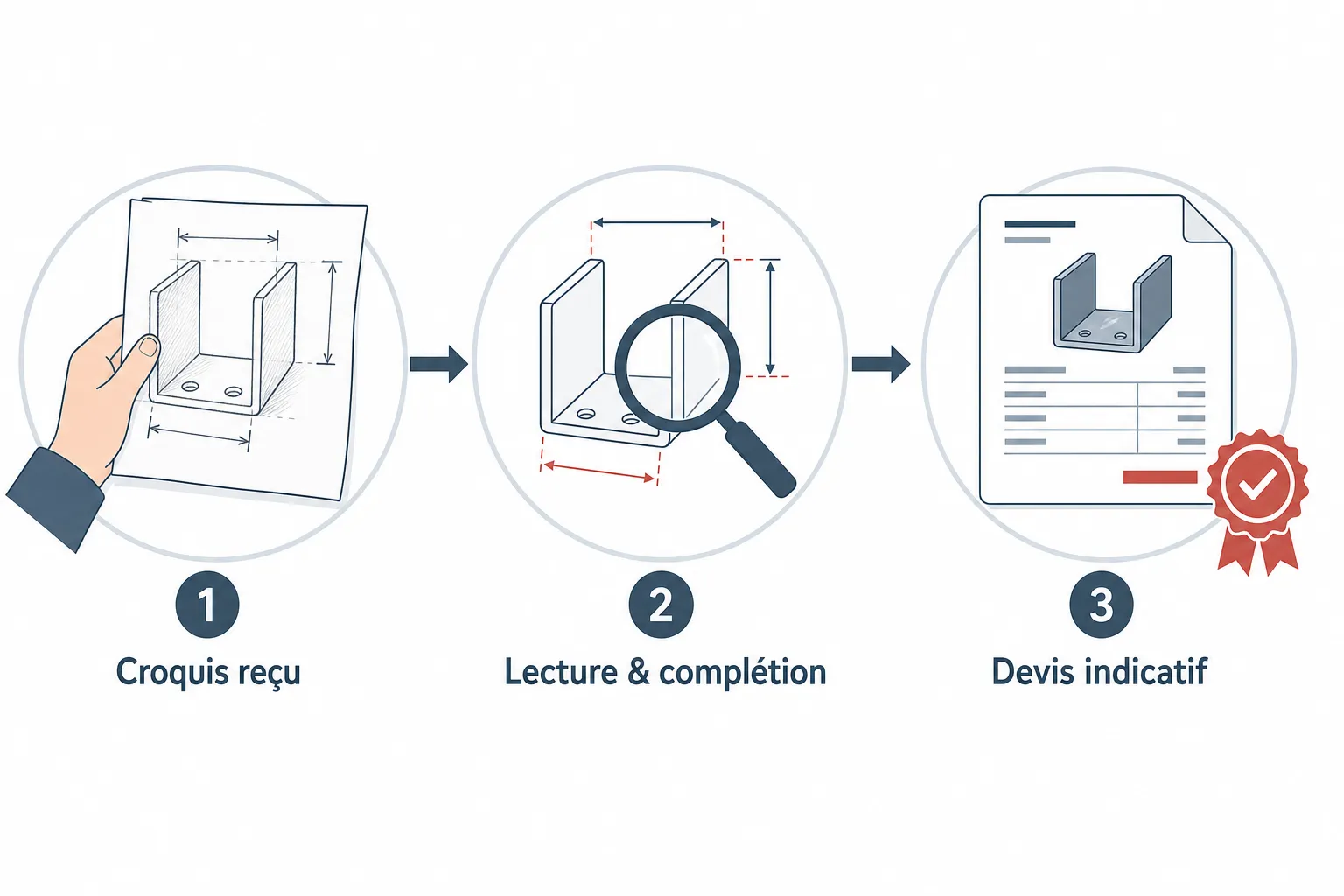
In a sheet metal shop, quoting eats up an enormous amount of time. A customer sends a photo of a sketch scribbled on the corner of a workbench, the thickness is missing, you call back, you dig out the spreadsheet, you calculate cutting, bends, drilling, shipping, you type up the quote. Multiply that by every request in a week, and it often ends up eating your evenings or weekends.
A quoting configurator promises to automate this. But most of the ones on the market can only handle a clean CAD file. Here's how an approach designed for the real input — the messy sketch — works, and what it actually does, without overselling.
What is a sheet metal quoting configurator?
It's a tool that turns a customer request into a priced quote, without you having to re-key everything by hand. The customer submits what they have (sketch, photo, drawing, message), the tool extracts the part's characteristics, calculates a price from your own quoting logic, and presents it to you for approval. The goal isn't to replace you, but to remove the repetitive part of quoting.
Do you need a clean CAD file to get a quote?
No, and that's exactly where the difference is. Classic configurators (Tempus Tools, ipLaser, Xometry) are excellent when the customer supplies a clean DXF or STEP file. But in the reality of a sheet metal shop, many requests come in as a photo, an annotated sketch or a scanned drawing. A configurator built for that kind of input goes looking for the information on the messy drawing, instead of sending everything that isn't a clean file off to a manual review.
How does the system read a hand-drawn sketch?
It analyzes the image and extracts what it recognizes: the shape of the part, the dimensions, the annotated material, the bends, the holes, the quantity. For each piece of information, it assesses its confidence. When a dimension is illegible or missing, it doesn't guess: it flags it and asks the customer to complete it — instead of a three-day back-and-forth by email. In cases where it has real doubt, it escalates to you rather than producing a shaky quote.
Where does the displayed price come from?
From your own quoting logic, not a generic price list. We model your calculation logic: material cost, cutting and bending time, drilling, finishing, shipping, margins. The configurator applies your rules. If the price of aluminum shifts, we update the parameter and your quotes follow. That's what makes the difference between a credible price and a cosmetic estimate.
Does the quote go out to the customer automatically?
No. The price is produced as indicative and shown to you before anything is sent. Your shop keeps control: you confirm, adjust or discard. Be wary of promises of "100% automatic quotes with no human" — on custom parts, a trained eye's sign-off remains essential, and a good tool is designed to leave you that final word.
And the quotes that never get a reply?
They're followed up automatically, at the pace you define, with an easy opt-out for the customer. It's revenue recovered on quotes you've already done, without you having to think about it. Many deals are lost not on price, but because no one followed up.
Does it replace the estimating department?
No. The tool removes the repetitive quoting and speeds up the first price; it doesn't design the part for you and doesn't replace your expertise. The right setting: the machine does the tedious work and flags what deserves your attention, you keep the technical decision and the final price.
In short
A well-designed sheet metal quoting configurator reads your customers' real input, fills in what's missing together with them, prices from your own spreadsheet and hands you back an indicative price to approve — then follows up on dormant quotes on its own. No magic, no "zero errors": a tool that gives you back the time spent on repetitive quoting while leaving you in control of the price.
To see in detail how this gets set up in a shop, the dedicated page explains how it works: the quoting configurator for sheet metal and laser cutting.
Frequently asked questions
How long does it take to set up a configurator? The longest part isn't the technology, it's modeling your quoting logic. We install it, calibrate the tool on a few of your real quotes to check that the prices match yours, then refine it over time.
Will my customers have to learn to use software? No. They send what they already send — a photo, a sketch, a message. It's the tool that adapts to them, not the other way around.
Is it software you buy once? No, it's a recurring service: installation, calibration, then ongoing maintenance and improvements. You're not left alone with a tool that's delivered and then abandoned.